Every few years, something shifts in the tech world that changes how we actually live — not just what gadgets sit on our desks. 2026 feels like one of those years.
It started with CES 2026 in Las Vegas in January, where artificial intelligence, next-generation chips, and bold new device form factors dominated nearly every conversation on the show floor. Then the momentum kept building. AI smartphones are selling in record numbers. Gaming hardware has taken a dramatic leap forward. And the definition of what a “personal device” even means is quietly being rewritten.
Whether you’re a tech enthusiast trying to keep up, a buyer deciding what to purchase next, or just someone who wants to understand what’s actually going on — this article covers the biggest stories in tech right now. Let’s break it down.
Part 1: Smartphones in 2026 — AI Is Now the Main Feature
The AI Smartphone Era Is No Longer Coming — It’s Here
For the past few years, smartphone manufacturers have been promising “AI-powered” features. In 2026, those promises have finally become real, everyday experiences that most users are actually noticing.
The key shift has been the rise of powerful Neural Processing Units (NPUs) built directly into smartphone chipsets. These dedicated AI chips allow your phone to handle complex tasks — real-time translation, image enhancement, voice transcription, content summarization — without sending your data to a remote server. It all happens on the device, in your pocket, in real time.
This matters for two reasons: speed and privacy. Processing AI tasks locally means near-instant results with no lag. It also means your personal data doesn’t have to travel across the internet to get a job done. For millions of users who’ve grown uneasy about data privacy, this is a genuinely meaningful improvement.
Industry forecasts suggest that by 2028, nearly 70% of all smartphones shipped globally will support generative AI capabilities. That’s not a niche feature anymore — it’s becoming the standard.
What Buyers Actually Want From AI Phones Right Now
When you look at what consumers are prioritizing in 2026, a few things stand out clearly. AI camera tools are at the top of the list — specifically the ability to remove unwanted objects from photos, enhance images in low light, and automatically create highlight reels from video. These aren’t gimmicks. For anyone who uses their phone as their primary camera, these features make a tangible difference in daily life.
Beyond photography, real-time language translation, voice memo summarization, and smart battery management are the features gaining the most traction. Phones that intelligently allocate processing power — ramping up for gaming, scaling back during light use — are outperforming competitors on real-world battery tests even when raw milliamp-hour specs look similar on paper.
It’s worth noting that AI smartphones are no longer exclusively a premium segment story. Budget and mid-range devices are beginning to include meaningful AI features, which is pushing the technology into billions of hands worldwide rather than just those who can afford flagship pricing.
Samsung’s Galaxy Z Trifold: The Boldest Smartphone of the Year
The single most talked-about smartphone reveal of 2026 so far is Samsung’s Galaxy Z Trifold, which made its US debut at CES 2026 and immediately became the most photographed device on the show floor.
As the name suggests, the Galaxy Z Trifold features three panels that fold into a compact, pocketable form factor — and unfold into a display large enough to rival a small tablet. Samsung has paired the hardware with deep Galaxy AI integration, making the large screen genuinely useful rather than just visually impressive.
It’s a bold bet. Foldable phones have been a hard sell in the past due to durability concerns and price tags that made mainstream adoption difficult. But Samsung’s hardware quality has improved dramatically with each generation, and the Trifold represents the company’s most ambitious statement yet that foldable form factors are the future of mobile — not a side experiment.
Whether the Trifold becomes a mass-market success or remains a premium curiosity is still an open question. But it signals where the industry’s imagination is headed.
AI Subscriptions on Smartphones: The Coming Debate
One development worth watching closely: some smartphone manufacturers have begun hinting that their most advanced AI features may shift to a subscription model in the near future. Right now, features like AI photo editing and on-device assistants are included with device purchases. But as the cost of developing and maintaining these systems grows, companies are exploring how to monetize them beyond the initial hardware sale.
This is still early-stage, but approximately 40% of smartphone users already express concern about how AI features collect and process their data. Add a potential monthly fee into that equation, and you have a meaningful consumer trust challenge on the horizon.
Part 2: Artificial Intelligence in 2026 — Smarter, Faster, and Everywhere
AI Has Moved Off the Screen and Into the Physical World
If 2024 and 2025 were defined by AI chatbots and software tools, 2026 is the year AI has started moving into physical objects. The term being used by industry insiders is “physical AI” — technology that doesn’t just respond to prompts in a chat window but perceives and interacts with the real world around it.
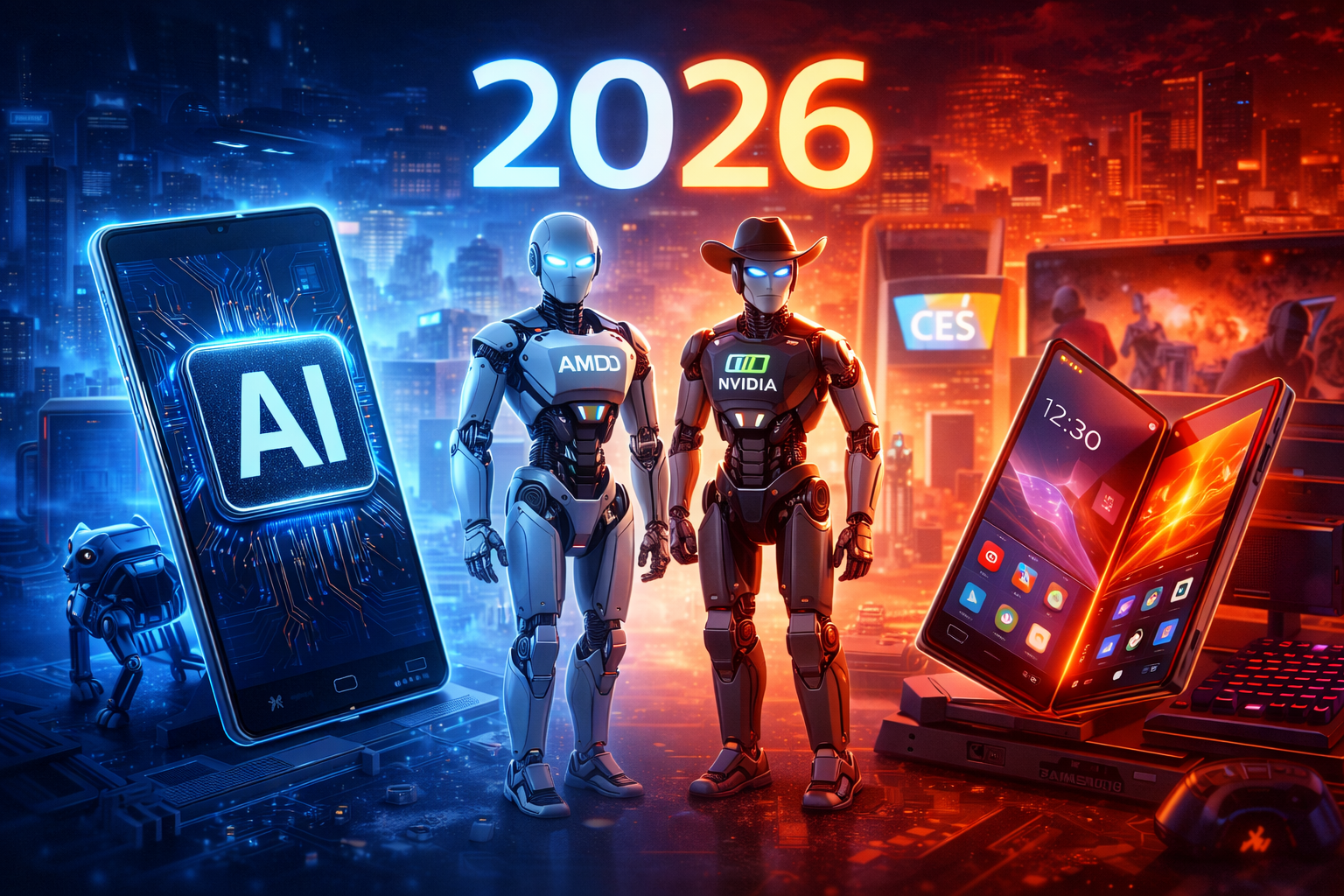
At CES 2026, this wasn’t theoretical. Humanoid robots were walking the show floor. NVIDIA’s event featured a cowboy hat-wearing humanoid bot, a robot simulating surgical procedures, and a helper robot assisting people with check-in tasks. AMD unveiled a humanoid robot called GENE.01 built on AMD processing technology. Intel had Oversonic Robotics’ RoBee robot on hand showing what Intel’s latest processors can do in a physical AI system.
This isn’t the clunky, slow robotics of previous generations. These machines move with a fluidity that was not possible just two or three years ago, and the pace of improvement is accelerating.
Google Gemini Is Coming to Your Living Room
Google made a significant move at CES 2026 by announcing that Gemini 3 — its latest AI model — is being integrated into Google TV. This means your television will be able to understand natural language commands, helping you search for content, edit and save photos to your screensaver, and eventually manage smart home devices through conversational interaction.
It sounds simple, but the implications are significant. Most smart TV interfaces today are clunky, slow, and frustrating to navigate. A genuinely intelligent natural language layer could make the TV one of the most AI-integrated screens in your home — and with Google’s data ecosystem behind it, the personalization potential is enormous.
The AI Regulation Battle Is Heating Up
Not all AI news in 2026 is about shiny new products. Behind the scenes, a major political and legal battle is unfolding over who gets to regulate artificial intelligence — and the outcome will shape the industry for decades.
In late 2025, President Trump signed an executive order aimed at limiting states’ ability to pass their own AI laws, pushing for a more uniform federal approach. States like California — which passed the nation’s first frontier AI safety law requiring companies to publish safety testing results for their models — have pushed back hard, arguing the order overreaches.
At the same time, the courts are beginning to weigh in on thorny questions that have no easy answers: Can AI companies be held responsible for harm caused by their chatbots? Can someone sue an AI company for defamation if its model spreads false information about them? These aren’t hypothetical cases. Real trials are expected in 2026, and the verdicts will matter enormously.
For anyone building a business or career around AI tools, this regulatory uncertainty is something to watch closely.
AMD’s Next-Generation AI Chip: Setting the Stage for 2027
On the hardware side, AMD revealed at CES 2026 that its next major AI chip — the MI500 — is planned for 2027, promising a staggering 1,000x performance increase over current offerings. The company also announced its Helios platform, focused on high-density AI infrastructure and open software, and highlighted partnerships with OpenAI and advancements in AI video generation.
These announcements aren’t about consumer products you’ll buy tomorrow. But they signal the continued ferocity of the AI chip arms race — and the enormous amounts of money and engineering talent being directed at making AI hardware faster, cheaper, and more efficient.
Part 3: Gaming in 2026 — NVIDIA Changes the Rules Again
NVIDIA DLSS 4.5: The Biggest Gaming Upgrade Nobody Is Talking About
If you follow PC gaming, you’ve heard of DLSS — NVIDIA’s Deep Learning Super Sampling technology that uses AI to generate high-quality frames from lower-resolution source images, dramatically boosting performance without sacrificing visual quality.
At CES 2026, NVIDIA announced DLSS 4.5, and it represents a substantial step forward. The headline feature is a second-generation Transformer-based Super Resolution model that delivers better temporal stability, less ghosting, and sharper anti-aliasing compared to previous versions. In plain English: games look cleaner and smoother than before, with fewer visual artifacts.
But the more exciting development is Dynamic Multi Frame Generation. On RTX 50-series graphics cards, DLSS 4.5 can generate up to five additional frames for every single traditionally rendered frame — effectively multiplying your performance output dramatically. NVIDIA is positioning this technology around high-end targets like 4K gaming at 240Hz with path tracing enabled, which was essentially impossible on consumer hardware just two years ago.
The 2nd Gen Super Resolution model is available now for all RTX GPU owners. The Dynamic 6x Frame Generation feature for RTX 50-series cards is expected to roll out in spring 2026, with support coming to hundreds of titles through the NVIDIA app.
G-Sync Pulsar: Motion Clarity Gets a Major Overhaul
Alongside DLSS 4.5, NVIDIA introduced G-Sync Pulsar — a new take on its variable refresh rate display technology designed to dramatically reduce motion blur.
Traditional monitors keep their backlight on continuously, which causes a smearing effect during fast motion. G-Sync Pulsar works by pulsing the backlight in sections rather than keeping it on uniformly, which effectively quadruples your perceived refresh rate. A 250Hz monitor with G-Sync Pulsar enabled delivers perceived motion clarity equivalent to over 1,000Hz. For competitive gamers where motion clarity directly affects reaction time and targeting accuracy, this is a meaningful real-world improvement.
The first G-Sync Pulsar monitors are arriving from Acer, AOC, ASUS, and MSI — all 27-inch 1440p IPS panels with 360Hz refresh rates and up to 500 nits peak HDR brightness. They also support Ambient Adaptive Technology, which automatically adjusts color temperature and brightness based on the lighting in the room.
Mobile Gaming Is Challenging Consoles in a Serious Way
One of the more surprising gaming stories of 2026 is the continued, dramatic rise of mobile gaming as a legitimate platform — not just for casual titles, but for serious, visually impressive games that would have required a dedicated console just a few years ago.
Mobile gaming apps generated over $103 billion globally last year. More importantly, the quality gap between mobile and console gaming is narrowing faster than most people expected. AI-powered resource management allows complex games to run smoothly on mid-range hardware. Cloud gaming integration means devices can stream graphically intensive titles without needing powerful local processors. And the fact that your phone is always in your pocket gives mobile gaming a distribution advantage no console can match.
Game developers are noticing. More studios are prioritizing mobile-native versions of major titles rather than treating them as afterthoughts. The traditional console release cycle of five to seven years is looking increasingly rigid in a market where mobile hardware updates annually and software can be distributed instantly.
Razer’s Project Ava: An AI Gaming Assistant That Lives on Your Desktop
One of the more intriguing gaming announcements at CES 2026 came from Razer. Project Ava is an AI-powered gaming assistant designed to sit on your desktop and provide real-time help — whether that means coaching you through a difficult section of a game, tracking your performance statistics, or managing your schedule around gaming sessions.
It’s an early concept, and there are legitimate questions about how polished the experience will be at launch. But the underlying idea — a persistent, context-aware AI companion that understands both your game and your broader digital life — points toward where gaming assistance is heading. The era of static, wiki-based guides is giving way to dynamic, personalized coaching powered by AI that watches and learns as you play.
What All of This Means for You
Whether you’re a consumer, a creator, or just someone trying to stay informed, 2026 is sending a clear message: AI is no longer a feature being added to technology. It’s becoming the foundation that technology is built on.
Smartphones are getting smarter in ways that actually improve daily life. The physical world is beginning to be filled with AI-powered devices that see, hear, and respond to their environment. Gaming hardware is making visual fidelity and performance accessible at price points that weren’t possible two years ago.
The pace of change is fast. Not every announcement will pan out. Not every product will deliver on its promise. But the direction is unmistakable — and 2026 is one of the more genuinely exciting years to be paying attention.
Conclusion: Stay Curious, Stay Informed
The tech landscape in 2026 is moving faster than at any point in recent memory. From AI-embedded smartphones that protect your privacy to NVIDIA’s frame generation technology pushing gaming visuals beyond what displays were even designed to handle — and from Samsung’s triple-fold screen to humanoid robots walking trade show floors — the breadth of what’s happening right now is remarkable.
The best thing you can do isn’t necessarily to rush out and buy the latest device. It’s to understand what’s actually changing, why it matters, and how it connects to your life. The technology being announced and released in 2026 will define what’s normal in 2028 and 2030. Staying informed now means you’ll be ready to take advantage of it when it matures.
Bookmark this space — we’ll keep covering every major development as it happens.
FAQ: Tech News 2026
Q: What are the biggest tech trends in 2026? A: The three dominant trends in 2026 are AI integration across all device categories, the rise of physical AI and robotics, and next-generation gaming technology. Smartphones, TVs, wearables, and even home appliances are now being built around AI as a core feature rather than an add-on.
Q: What is the best AI smartphone in 2026? A: The best AI smartphones in 2026 are those with powerful Neural Processing Units (NPUs) that handle AI tasks on-device — without sending data to the cloud. Samsung’s Galaxy S26 series and other flagship devices with dedicated AI chips currently lead the market. The best choice depends on your budget, preferred OS, and which AI features matter most to your daily use.
Q: What is Samsung’s Galaxy Z Trifold? A: The Samsung Galaxy Z Trifold is Samsung’s latest foldable smartphone featuring three panels that fold together into a compact device and unfold into a large tablet-sized display. It was unveiled at CES 2026 in Las Vegas and includes Samsung’s Galaxy AI features. It represents Samsung’s boldest foldable design to date.
Q: What is NVIDIA DLSS 4.5 and how does it improve gaming? A: DLSS 4.5 is NVIDIA’s latest version of its AI-powered upscaling and frame generation technology. It uses a second-generation Transformer model to deliver cleaner, sharper visuals with less ghosting. On RTX 50-series GPUs, its Dynamic Multi Frame Generation feature can generate up to five extra frames per traditionally rendered frame, dramatically boosting performance for demanding games at resolutions like 4K.
Q: What is G-Sync Pulsar? A: G-Sync Pulsar is NVIDIA’s new variable refresh rate display technology designed to reduce motion blur by pulsing the monitor’s backlight in sections rather than keeping it on continuously. This effectively quadruples the perceived refresh rate, making fast-motion content — especially in competitive gaming — significantly clearer and smoother.
Q: Is mobile gaming becoming as good as console gaming? A: Mobile gaming is narrowing the gap with consoles faster than expected. With AI-powered performance management, cloud gaming integration, and increasingly powerful mobile chipsets, high-quality gaming experiences are now possible on smartphones. The mobile gaming market generated over $103 billion globally last year, reflecting its massive scale and growth.
Q: What did AMD announce at CES 2026? A: AMD announced several new CPUs for laptops and desktops at CES 2026, along with its Helios AI infrastructure platform featuring the MI455X GPU. The company also previewed its MI500 AI chip planned for 2027, which it claims will deliver a 1,000x performance increase. AMD also unveiled the GENE.01 humanoid robot powered by AMD processing technology.
Q: Will AI smartphone features become subscription-based? A: Some manufacturers have hinted that advanced AI features currently bundled free with devices may eventually move to subscription pricing as development costs increase. Nothing has been formally announced, but it’s a trend worth watching — especially for buyers who are making long-term device decisions today.
Q: What is “physical AI” and why does it matter? A: Physical AI refers to artificial intelligence integrated into physical devices and robots that can perceive and interact with the real world — rather than existing only as software tools. Examples include humanoid robots, AI-powered vehicles, and smart appliances that respond to their environment in real time. CES 2026 marked the first year physical AI truly dominated a major tech event, signaling a shift from software-focused AI to embodied AI.