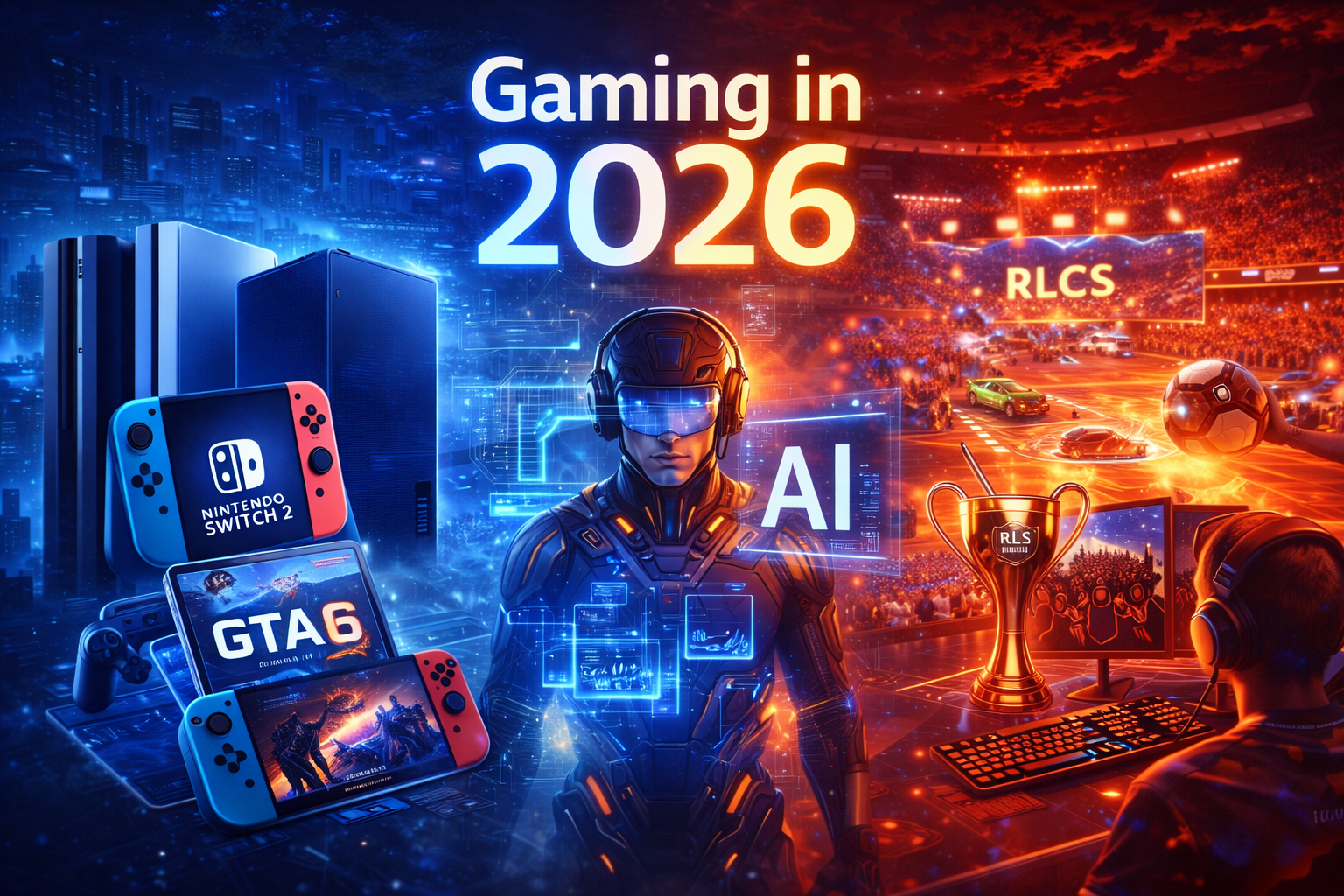
The video game industry has always moved fast. But 2026 feels different — not just in terms of new hardware and bigger game releases, but in how the very foundation of the industry is being rewritten.
The hardware cycle that once defined the gaming world — where console launches every five to seven years shaped everything from developer roadmaps to consumer spending — is under serious pressure. Artificial intelligence is changing how games are built and played. Esports has evolved from a niche internet subculture into a global media industry with hundreds of millions of viewers. And the line between console gaming, mobile gaming, and streaming is dissolving faster than most people expected.
Whether you’re a casual gamer, a die-hard enthusiast, or someone who works in the industry, 2026 is a year you’ll want to pay close attention to. Let’s dig into the three biggest stories reshaping gaming right now.
New Consoles — A Console War That Looks Nothing Like Before
Nintendo Switch 2 Is the Surprise Story of the Year
Going into 2026, most gaming analysts expected the hardware narrative to be dominated by Sony and Microsoft. What happened instead is that Nintendo stole the show — quietly and decisively.
The Nintendo Switch 2 has exceeded virtually every expectation set for it. Capable of rendering games at up to 4K resolution in docked mode, supporting NVIDIA’s DLSS upscaling technology, and running demanding third-party titles that the original Switch couldn’t dream of handling — the Switch 2 has repositioned Nintendo as a serious player in the AAA game space, not just a family-friendly alternative.
The game library has followed. Cyberpunk 2077 runs surprisingly well on the Switch 2. Final Fantasy VII Remake arrived on the platform and by multiple accounts performs impressively. Red Dead Redemption 2 is confirmed for Switch 2, having received an ESRB rating — a clear sign from Rockstar that they’re taking the platform seriously. These are games that would have seemed impossible on a Nintendo handheld just three years ago.
What’s most impressive about the Switch 2 story isn’t the hardware itself — it’s how Nintendo has used the platform to attract developers and publishers who previously ignored them entirely. That’s a tectonic shift, and it’s creating a richer game library than Nintendo has offered in years.
GTA 6: The Game That Will Define 2026 — And Possibly 2027
No single game title has generated more conversation in the gaming industry this year than Grand Theft Auto 6. After years of anticipation and a delay that rattled investor confidence and briefly dropped Take-Two Interactive’s stock price, GTA 6 is now locked in for a November 19, 2026 launch on PlayStation 5 and Xbox Series X/S.
The scale of what Rockstar is promising is genuinely staggering. Early leaks and officially released materials point to over 700 enterable buildings, a dual-protagonist story, a dramatically expanded version of Vice City, and physics and environmental detail that push current-gen console hardware to its limits. Industry analysts are calling it a generational launch — not just for gaming, but across all entertainment categories.
For the console market specifically, GTA 6 is expected to provide a significant boost to hardware sales. Sony is positioned to capture the largest share of that wave, given PlayStation 5’s dominant market position in North America and Europe. Microsoft and Xbox will benefit too, though in a more modest way given the platform’s declining hardware momentum.
The big unresolved question is whether GTA 6 will ever come to Nintendo Switch 2. Rockstar has reportedly conducted internal tests to explore the possibility, and multiple credible leakers have suggested a port is under consideration. However, the official launch is PS5 and Xbox Series X/S only — and given how graphically demanding the game is, a Switch 2 version remains a significant technical challenge. If it happens at all, it won’t be on day one.
Xbox Is No Longer a Console Business — And That Might Be Fine
The most uncomfortable conversation in gaming right now centers on Xbox and where Microsoft’s gaming division is actually headed. Hardware sales have been declining, and the brand’s cultural presence has weakened considerably compared to its Xbox 360 era peak.
But something interesting is happening beneath the surface. Microsoft recently appointed Asha Sharma as a senior executive in its gaming division — a leader whose background comes from scaling digital platforms at Instacart and Meta rather than managing console launches. That appointment tells you something important about how Microsoft sees its own future.
Xbox is quietly evolving from a box under your television into a cross-platform software ecosystem. Game Pass is available on PC, console, and through cloud streaming. Microsoft’s biggest franchises are now playable on PlayStation and Nintendo platforms. The company’s investment in cloud gaming infrastructure and AI tools for game development suggests a long-term strategy built around software and services rather than hardware dominance.
Is this a retreat or a strategic pivot? Probably both. But for gamers, the practical result is that Xbox’s game library becomes more accessible — not less — as the platform boundaries loosen. The era of console exclusivity as the primary battleground is ending, and Microsoft may be better positioned for the world that comes after than its current hardware sales suggest.
Sony Is Playing It Smart and Steady
While Xbox reinvents itself and Nintendo surprises everyone, Sony is doing what Sony does best: protecting its strengths and staying patient.
PlayStation 5 remains the dominant console in the key Western markets. Sony’s first-party studio lineup — led by exclusives that consistently win critical acclaim and drive hardware sales — continues to be the strongest in the industry. The upcoming Wolverine game is among the most anticipated PlayStation exclusives of the year, and Sony’s continued investment in story-driven, cinematic gaming experiences resonates with a huge audience.
There’s also credible speculation that Sony is developing a dedicated handheld device to complement the PS5 — not a streaming accessory like the PlayStation Portal, but an actual standalone gaming handheld. If Nintendo’s Switch 2 success has proven anything, it’s that there’s massive demand for premium portable gaming. Sony has the library and the brand recognition to be a genuine player in that space.
AI in Gaming — The Creative Engine Is Being Rebuilt
AI Is Now Inside the Development Process, Not Just the Games
A few years ago, AI in gaming meant smarter enemy behavior or procedurally generated terrain. In 2026, artificial intelligence has moved deep into the game development pipeline itself — and the industry is only beginning to understand what that means.
Studios are now using AI tools to generate dialogue trees, create environmental art assets, write and test code, design level layouts, and run quality assurance at a scale that would have required hundreds of additional human hours just two years ago. The practical result is that development timelines for certain types of content are shortening, and smaller studios can produce more ambitious games with leaner teams.
The AI in gaming market was valued at around $4.5 billion in 2025 and is projected to reach over $81 billion by 2035 — a growth rate of roughly 33% per year. That’s not hype. That’s where actual money is flowing, which is about as reliable a signal as any that this technology is becoming foundational to how games get made.
On-Device AI Is the Next Frontier
One of the most technically significant trends of 2026 is the migration of AI processing from remote servers directly onto consumer devices. This shift is happening for practical reasons: cloud-based AI processing introduces latency that makes real-time gameplay experiences difficult, and the cost of running AI models on servers at scale is substantial.
The result is that new games are being designed around on-device AI — using the dedicated AI processing cores built into NVIDIA RTX graphics cards, AMD chips, and even mobile processors to run machine learning models locally. This enables features that simply weren’t possible before: NPCs that respond to player behavior with genuine contextual awareness, game worlds that dynamically adapt their narrative based on choices made dozens of hours earlier, and difficulty systems that fine-tune themselves moment to moment based on your actual play patterns rather than preset difficulty levels.
Steam is already tracking this shift. At the start of 2023, only a handful of games on the platform disclosed AI usage. By the end of 2025, that number had reached 4,311 — a 4,750% increase over the baseline. The volume for 2026 is on track to exceed all of 2023’s total just partway through the year. The disclosure numbers are a rough proxy for adoption, but the trend is unmistakable.
Smarter NPCs Are Changing What Games Feel Like
Perhaps the most exciting application of AI for everyday players is what’s happening to non-player characters. Traditional NPCs follow scripted dialogue trees and respond to predetermined triggers. Even the most sophisticated versions feel mechanical after a few hours.
AI-driven NPC systems in 2026 are genuinely different. Using natural language processing and real-time behavioral analysis, characters can carry on conversations, remember past interactions, adapt their attitude based on how you’ve treated them, and react to the broader context of what’s happening in the game world around them. They aren’t just responding to inputs — they’re behaving.
This changes the emotional texture of games in ways that are hard to describe without experiencing them. When an NPC feels like it’s actually listening and reacting rather than executing a script, the relationship between player and game world becomes more immersive and more personal. That’s not a small thing — it’s arguably the most meaningful improvement in gameplay feel since the introduction of physics engines.
The AI Backlash Is Real Too
It’s worth being clear-eyed about the other side of this story, because not all AI news in gaming is positive.
There’s a growing and legitimate backlash among game developers and players against what some are calling “AI slop” — AI-generated content that lacks craft, personality, and the human intention that makes great games great. Some studios have leaned too heavily on generative AI for art assets, dialogue, and even level design, producing content that feels hollow and interchangeable.
The legal landscape around AI in games is also unsettled and contentious. Questions about copyright ownership of AI-generated content, the rights of artists whose work was used to train AI models, and liability for harm caused by AI-powered systems are working their way through courts and regulatory bodies in multiple countries. The outcomes of these cases will shape how studios can actually use AI tools going forward.
The studios that will win in this environment are those that use AI as a tool to amplify human creativity — not replace it. The technology is powerful, but it still needs direction, taste, and intention from the people wielding it.
Esports — The Industry Is Growing Up
Mobile Esports Has Officially Overtaken PC in Scale
For years, PC gaming was treated as the premium tier of competitive gaming. Console esports was seen as secondary. Mobile esports barely registered in Western conversations. 2026 has definitively changed that hierarchy.
The M7 World Championship — the flagship tournament for Mobile Legends: Bang Bang — recently reached a peak of 5.68 million concurrent viewers, shattering previous industry benchmarks. During the tournament’s finals, TikTok alone hit 2.42 million live viewers simultaneously. These numbers don’t just rival traditional PC esports events — they exceed them by a significant margin.
The geography of this shift matters enormously. Approximately 57% of the global esports audience is now concentrated in the Asia-Pacific region, where mobile is the primary gaming platform and competitive mobile titles have massive cultural presences. Western esports organizations and brands that have spent years building PC-centric strategies are scrambling to adapt to a mobile-first reality.
For brands and sponsors, mobile esports offers something particularly compelling: a direct conversion path from viewing to action. When a viewer watches a mobile esports tournament on their phone and can download the featured game with a single tap, the funnel from audience to player to paying customer is tighter than anything traditional esports can offer.
The Business Model Has Matured — For Better and Worse
The venture-capital-fueled era of esports — where organizations raised enormous sums, paid inflated player salaries, and chased scale at any cost — is firmly over. The hangover from that period has been painful for many organizations, and the industry is still working through the consequences.
What’s replacing it is more sustainable but also more demanding. Successful esports organizations in 2026 are building around high-margin revenue streams: premium memberships, exclusive content, merchandise with genuine brand identity, and utility-based sponsorships where brands are woven into the fan experience rather than interrupting it.
The shift toward what industry analysts are calling “utility-based partnerships” is particularly significant. Brands are no longer satisfied with having their logo on a jersey or a banner on a broadcast. They want to power the actual infrastructure fans use — the statistical tracking tools, the interactive maps, the digital hubs where viewers engage with the event in real time. A sponsor that provides genuine value to fans is seen rather than skipped. That’s a fundamentally different relationship, and it’s pushing esports marketing in a more sophisticated direction.
Rocket League Sets a Viewership Record
Amid the broader esports evolution, Rocket League delivered one of the year’s most impressive individual moments: the RLCS 2026 Boston Major achieved the highest viewership in the game’s competitive history. For a title that has been in the esports ecosystem for nearly a decade, hitting a new peak in 2026 is a remarkable achievement — and a reminder that well-run competitive programs can sustain audience growth long after a game’s initial popularity spike.
The Boston Major success points to something the esports industry sometimes overlooks: event production, community engagement, and competitive format quality matter enormously. Fans will show up in record numbers for events that feel important and well-executed. The spectacle has to match the competition.
Agentic AI Is Coming to Esports Operations
While on-device AI is transforming gameplay, a different kind of artificial intelligence — agentic AI — is beginning to reshape how esports organizations operate behind the scenes.
Agentic AI refers to systems that can act autonomously across complex tasks: scheduling, data analysis, content localization, player performance tracking, anti-cheat monitoring, and broadcast production support. These systems don’t replace the humans making strategic decisions, but they dramatically reduce the operational overhead required to run a professional esports organization at scale.
For smaller organizations and emerging markets, this is potentially transformative. Competing with larger, better-funded rivals on operational efficiency becomes more achievable when AI handles a significant portion of the back-office workload. Expect to see this technology become a meaningful competitive advantage for organizations that adopt it early.
What the Next 12 Months Look Like
Looking ahead, a few things stand out clearly.
GTA 6 launching in November will be the defining consumer moment of the year for gaming — full stop. The game’s reception and sales performance will influence publisher strategies, hardware sales, and industry sentiment well into 2027.
Nintendo Switch 2 will continue to gain momentum as its third-party library grows. The question of whether it attracts a GTA 6 port — even a delayed one — could determine how the console is remembered in the long run.
AI will become more visible to everyday players through smarter NPCs, personalized difficulty, and AI-assisted content creation tools that some games will offer directly to players. Expect the first major controversy around AI-generated game content to land within the next year.
Mobile esports will continue to challenge the Western PC-centric view of competitive gaming, and brands that move early into mobile-first sponsorship strategies will have a meaningful head start.

Conclusion: The Old Rules Don’t Apply Anymore
The gaming industry in 2026 is at a genuine inflection point. The traditional console hardware cycle is under strain. AI is rewiring how games get made and played. Esports has matured from a speculative bet into a disciplined, global media business. And the boundaries between platforms — console, PC, mobile, cloud — are dissolving in ways that make the old categories feel increasingly irrelevant.
None of this means gaming is in trouble. Quite the opposite. The industry is more creative, more accessible, and more global than it has ever been. But the companies and creators who will define its next chapter are those willing to let go of how things used to work and build for what’s actually coming.
The rulebook has been rewritten. The most exciting part is figuring out what the new game looks like.
FAQ: Gaming Industry News 2026
Q: What are the biggest gaming trends in 2026? A: The three dominant trends are AI integration in game development and gameplay, the rise of mobile esports as the world’s largest competitive gaming platform, and the shift of major publishers like Microsoft away from hardware-exclusive strategies toward cross-platform software and service ecosystems.
Q: When is GTA 6 coming out? A: Grand Theft Auto 6 is officially scheduled for release on November 19, 2026, on PlayStation 5 and Xbox Series X/S. A PC release date has not been confirmed, though Take-Two has acknowledged PC’s growing importance. A Nintendo Switch 2 version has not been officially announced, though Rockstar is reportedly conducting internal tests.
Q: Is Nintendo Switch 2 worth buying in 2026? A: The Nintendo Switch 2 has significantly exceeded expectations in terms of hardware capability and third-party game support. With titles like Cyberpunk 2077, Final Fantasy VII Remake, and Red Dead Redemption 2 confirmed or running on the platform, it offers a strong library for both dedicated Nintendo fans and players who want premium AAA experiences in a portable form factor.
Q: Is Xbox dying in 2026? A: Xbox hardware sales have declined significantly, but Microsoft is strategically repositioning its gaming division around software, services, and cloud infrastructure rather than console hardware sales. Game Pass and cross-platform game availability suggest a future where Xbox is a software brand that travels across screens rather than a console manufacturer.
Q: How is AI changing game development in 2026? A: AI tools are now used throughout the game development pipeline — generating art assets, writing and testing code, designing levels, creating dialogue, and running quality assurance. On-device AI is enabling smarter NPCs, adaptive difficulty systems, and personalized narrative experiences. Over 4,300 games on Steam disclosed AI usage by end of 2025, with 2026 on track to far exceed that number.
Q: What is the biggest esports event of 2026 so far? A: The M7 World Championship for Mobile Legends: Bang Bang reached a peak of 5.68 million concurrent viewers, making it one of the most-watched esports events in history. The RLCS 2026 Boston Major for Rocket League also set a new viewership record for that game’s competitive history.
Q: Is mobile esports bigger than PC esports now? A: By viewership and geographic scale, mobile esports has surpassed traditional PC esports in 2026. With 57% of the global esports audience based in Asia-Pacific — where mobile is the dominant gaming platform — mobile titles are generating peak viewership numbers that exceed most major PC esports events. The shift has significant implications for brands and sponsors building esports strategies.
Q: Will GTA 6 come to Nintendo Switch 2? A: As of now, GTA 6 is only confirmed for PlayStation 5 and Xbox Series X/S. Multiple credible leakers suggest Rockstar has conducted internal tests to explore a Switch 2 port, but no official announcement has been made. Given the game’s graphical demands, any Switch 2 version would likely come well after the main console launch — if it happens at all.
Q: What is the future of Xbox? A: Microsoft appears to be transitioning Xbox from a console-first brand into a cross-platform gaming ecosystem built around Game Pass subscriptions, cloud gaming, and software distribution across PlayStation, Nintendo, and PC platforms. Recent executive appointments suggest the company sees its future in digital platform management rather than hardware manufacturing.
Q: How big is the AI in gaming market? A: The AI in gaming market was valued at approximately $4.54 billion in 2025 and is projected to grow at a compound annual growth rate of around 33.6%, potentially reaching over $81 billion by 2035. North America currently holds the largest revenue share, while Asia-Pacific is growing at the fastest rate.