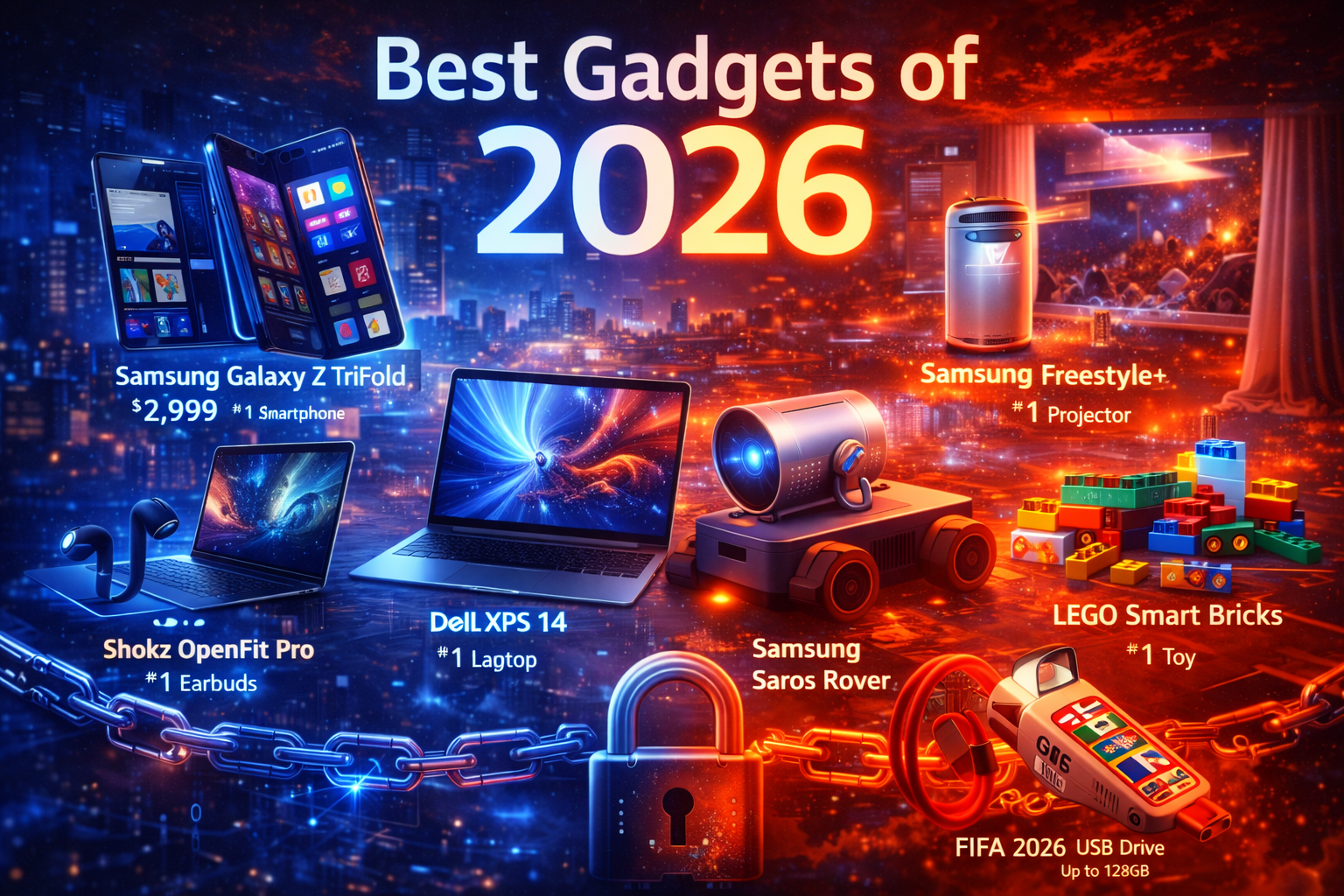
Every January, CES in Las Vegas floods the internet with hundreds of gadget announcements, bold promises, and flashy concept products that may or may not ever see the inside of a retail store. Add in the steady stream of product launches that followed throughout early 2026, and it can feel completely overwhelming to figure out what’s actually worth your time — and your money.
That’s exactly what this guide is for.
We’ve cut through the noise, looked at what real reviewers and hands-on testers said after the hype settled, and put together a category-by-category breakdown of the gadgets that genuinely deliver in 2026. Whether you’re shopping for yourself, upgrading an aging device, or just trying to understand what’s worth following, this is your starting point.
Let’s get into it.
Smartphones — Two Directions, One Clear Winner Per Budget
Samsung Galaxy Z TriFold — The Most Ambitious Phone of the Year
Price: ~$2,999 | Verdict: Buy if you want the future today
Samsung’s Galaxy Z TriFold is the most talked-about smartphone of 2026, and for good reason. This is Samsung’s first triple-fold device — two hinges, three panels — that collapses into a phone with a 6.5-inch cover screen and unfolds into a full 10-inch tablet display. When it’s closed, it’s barely thicker than a regular flagship phone. When it’s open, it’s genuinely tablet-sized.
Hands-on reviewers at CES 2026 called it a remarkable feat of engineering. The device carries Qualcomm’s Snapdragon 8 Elite for Galaxy processor, five cameras across its panels, and a 5,600mAh battery — the largest Samsung has ever shipped in a foldable. Galaxy AI features are baked throughout, with the large screen enabling productivity workflows that simply aren’t possible on a single-panel phone.
The elephant in the room is the price. At roughly $3,000, the Z TriFold is firmly in luxury territory. The foldable form factor also still carries some inherent durability trade-offs compared to traditional slab phones. But if you want to experience where smartphones are genuinely headed, and you have the budget to get there early, this is the most impressive phone money can buy in 2026.
Who it’s for: Power users, early adopters, and professionals who live in their phone’s display and want the productivity of a tablet without carrying two devices.
Who should wait: Anyone on a tight budget, anyone who has had bad experiences with foldable durability, and anyone whose existing phone still works well.
The Mid-Range Sweet Spot: AI Phones Under $600
The most compelling value story in smartphones right now isn’t at the top of the market — it’s in the middle. The $400–$600 price bracket has seen a dramatic improvement in 2026, with multiple devices now offering on-device AI processing, genuinely good cameras, and clean software experiences that rival flagships from just two years ago.
The key thing to look for when evaluating mid-range AI phones is the presence of a dedicated Neural Processing Unit. Phones with proper NPU hardware handle AI camera tasks, real-time transcription, and smart battery management locally — without lag and without sending your data to a remote server. Phones that market “AI features” but lack a dedicated NPU are essentially running those features through cloud processing, which is slower and raises more privacy questions.
If you’re in the market for a new daily driver and don’t want to spend flagship money, 2026 is genuinely the best time in recent memory to buy a mid-range phone.
Laptops — Two Standout Performers in a Crowded Field
Dell’s XPS lineup has been one of the most beloved premium Windows laptop lines for years — but the last two generations introduced design decisions that frustrated users badly. The virtual function key row was widely criticized as an accessibility problem, and the “invisible” trackpad drew complaints from reviewers and everyday users alike.
The 2026 Dell XPS 14 fixes both of these issues. Physical function keys are back, the trackpad is properly visible and redesigned for comfort, and the overall chassis is thinner and more refined than its recent predecessors. Paired with Intel’s Core Ultra Series 3 chips, this is now arguably the strongest challenger to the Apple MacBook Air for the thin-and-light crown on Windows.
For anyone who has been waiting for Dell to sort out the XPS design problems, 2026 is the year to finally pull the trigger. The hardware is beautiful, the performance is strong, and the fundamentals that made XPS laptops great are back where they belong.
Lenovo ThinkPad P1 Gen 8 — The Professional’s Choice
It’s genuinely hard to get excited about a work laptop at first glance, but the ThinkPad P1 Gen 8 earns its reputation. The 3.2K OLED display is stunning — not just by workstation standards, but by any standard. The keyboard remains one of the best typing experiences available on any laptop. And despite being a workstation-class machine, it’s relatively thin and light for what it offers.
This isn’t the laptop for gamers or creative professionals who need maximum GPU power. But for lawyers, engineers, consultants, financial analysts, and anyone else who spends long days in documents, spreadsheets, and presentations — and wants a display that doesn’t make their eyes hurt by 3pm — the P1 Gen 8 is a serious contender worth looking at.
Earbuds & Audio — Open-Ear Finally Has an Answer
Shokz OpenFit Pro — The Open-Ear Earbud Problem Is Solved
Open-ear earbuds have always had an obvious drawback: because they sit outside the ear canal rather than inside it, adding meaningful noise cancellation has been an engineering challenge nobody had convincingly cracked. Until now.
Shokz debuted the OpenFit Pro at CES 2026, and hands-on reviewers were genuinely impressed. The brand has found a way to deliver real noise reduction in an open-ear design — something its competitors, including Bose’s popular Ultra Open Earbuds, haven’t managed. Testers on the CES show floor noted the noise reduction as immediately noticeable and practically useful, not just a marketing checkbox.
What makes this significant isn’t just the technical achievement — it’s the use case it unlocks. Open-ear earbuds are popular with runners, cyclists, and commuters who want to stay aware of their surroundings while still enjoying audio. Adding noise reduction to that equation means you can use them in louder environments — a coffee shop, an open office, a flight — without sacrificing the situational awareness that made you choose open-ear in the first place.
Shokz has also priced the OpenFit Pro more aggressively than Bose’s equivalent offering, which makes the value proposition even stronger. If you’ve been waiting for open-ear earbuds to grow up, they have.
Fender Mix Wireless Headphones — Modular Audio Done Right
A Smart Buy for Audio Enthusiasts
Fender’s entry into premium wireless headphones is more serious than the brand licensing might suggest. The Mix headphones impressed CES listeners with their sound quality, but the real story is the modular design philosophy behind them.
Everything that typically becomes a point of failure over time — earcups, headbands, and the battery — is swappable. That matters because battery degradation is the primary reason most people replace their wireless headphones after two or three years. If you can simply swap a battery rather than buying a new pair, the long-term value of an already good pair of headphones improves dramatically.
This approach to repairability and longevity feels genuinely forward-thinking in a category that has historically pushed users toward regular replacement cycles. For anyone who values long-term value over novelty, the Fender Mix is worth a serious look.
Smart Home — Practical Beats Gimmicky
iOttie Arkx Portable Air Pump — The $80 Trunk Essential
Not every standout gadget of the year needs to be a technological marvel. Sometimes the best products are the ones that solve a real problem simply and reliably — and the iOttie Arkx Portable Air Pump is exactly that.
This compact three-in-one device can re-inflate tires and other inflatables, recharge your devices via a built-in 5,200mAh battery, and act as a light source in three modes — flashlight, ring light, and red SOS beacon. It’s compact enough to live in your trunk without taking up meaningful space, and at $80 it’s priced for the real world rather than the aspirational world.
CNN Underscored’s editorial team singled it out as one of the most practical CES 2026 finds precisely because it solves problems every driver faces — a flat tire, a dead phone, a dark roadside situation — in a single small package. If your car trunk doesn’t already have something like this, it should.
Roborock Saros Rover — The Robot Vacuum That Climbs Stairs
The robot vacuum category has been steadily improving for years, but one limitation has remained stubbornly constant: stairs. Most robovacs clean a single floor, then sit at the edge of a step, completely helpless. The Roborock Saros Rover changes that.
At CES 2026, the Saros Rover demonstrated the ability to navigate stairs using two wheels at the end of extendable legs, lifting itself step by step from one floor to the next. Tom’s Guide called it the most elegant solution among the several CES 2026 companies that attempted stair-climbing robovacs — a significant endorsement given how difficult the engineering challenge is.
The caveat here is that stair-climbing robovacs are new technology, and real-world reliability over months and years of use remains to be proven. Early adopters should go in with eyes open. But for multi-story homes where running a separate robovac on each floor is a hassle, the Saros Rover represents exactly the kind of practical leap that makes a product genuinely exciting rather than just technically impressive.
Samsung The Freestyle+ Projector — A Projector That Works Anywhere
Best Portable Projector of the Year
Portable projectors have always had a frustrating limitation: they need a flat, clean, light-colored surface to produce a decent image. Walls with texture, curtains, colored surfaces — they all degrade the picture quality significantly.
Samsung’s The Freestyle+ addresses this head-on. Using advanced image correction technology, it can project onto irregular surfaces — including flowing curtains, which is typically a nightmare scenario for projectors — and automatically correct the image into a clean, watchable rectangle. CNN Underscored’s senior tech editor described it as their first genuine “wow moment” of CES 2026, which is a meaningful bar to clear in a week full of impressive announcements.
For anyone who wants a flexible home entertainment setup — a living room one night, a bedroom the next, a backyard movie screening on the weekend — the Freestyle+ removes the practical limitations that made portable projectors feel compromised compared to a fixed TV. That flexibility is genuinely valuable for the right household.
Wearables — Health Gets Smarter
Garmin Integration with Food Tracking — The Fitness Ecosystem Grows Up
Best Upgrade for Existing Garmin Users
Garmin made a quiet but significant announcement in early 2026: native food tracking integration built directly into its sports watch ecosystem and Garmin Connect platform. For context, Garmin already makes some of the most respected sports and fitness watches on the market — devices that serious runners, cyclists, and outdoor athletes rely on for performance data.
Adding food tracking to that ecosystem is meaningful because it closes the loop between calorie consumption and calorie expenditure in a single platform, rather than requiring users to juggle separate apps. For anyone serious about fitness goals — weight management, endurance performance, recovery optimization — having nutrition data alongside training data in one place is genuinely useful.
Tom’s Guide noted that built-in food tracking paired with Garmin’s watch ecosystem could convert even skeptical users into Garmin Connect subscribers, which speaks to how well it integrates with what Garmin already does well. For existing Garmin watch owners, this feature alone is worth exploring.
Withings Home Health Monitoring — Prevention Before the Doctor’s Office
Verdict: Forward-Thinking Buy for Health-Conscious Households
Withings, the Paris-based wellness technology company, has been building at-home health monitoring devices for years, and their 2026 lineup doubles down on preventative health in a meaningful way.
The broader trend here is worth understanding: healthcare costs are rising, doctor’s appointments are harder to get, and most people have very little visibility into their own health metrics between annual checkups. Devices that provide clinically meaningful data at home — blood pressure, heart rhythm, sleep quality, body composition — allow people to catch warning signs earlier and have more informed conversations with their doctors when they do get an appointment.
Withings’ approach is more medically serious than most consumer wellness gadgets, and their track record gives them credibility that newer entrants lack. If preventative health monitoring is something you’ve been thinking about, their 2026 lineup is worth investigating.
Accessories & Everyday Carry — Small Gadgets, Big Impact
LEGO Smart Bricks — The Toy of the Year (For All Ages)
LEGO made its first-ever appearance at CES in 2026, and the reason was significant: Smart Bricks. These are LEGO bricks packed with sensors that allow them to interact with nearby smart tiles through lights and sound, creating an interactive building experience unlike anything LEGO has done in its history.
The concept is built around discovery and experimentation — builders can introduce smart bricks across different LEGO universes, triggering interactions they didn’t explicitly design. It turns LEGO building from a static creative exercise into a dynamic, reactive one where what you build actually responds to itself and its environment.
Reactions have been mixed in the most interesting way: some longtime LEGO fans feel the addition of technology changes what makes LEGO special. Others see it as a natural evolution that keeps the brand relevant for a generation of children who grow up interacting with responsive, connected environments. Whatever your take, there’s no question LEGO Smart Bricks represent genuinely new ground — and that’s rare for a brand with over 90 years of history.
SanDisk FIFA World Cup 2026 USB Drive — Practical Meets Collectible
This one is worth including because it represents something the best product design always achieves: making a completely ordinary object feel special without sacrificing function.
SanDisk created a USB-C flash drive shaped like a referee’s whistle for the FIFA World Cup 2026, with editions covering each of the three host countries — the USA, Canada, and Mexico — plus a Global Edition and a premium Gold Edition. The drive packs up to 128GB of storage with read speeds of 300MB/s, which means this is a genuinely fast, genuinely useful storage device wrapped in design that makes it feel like a piece of memorabilia rather than a disposable tech accessory.
The whistle shape is practical in its own strange way — distinctive enough that you won’t lose it in a drawer full of cables, and the loop design lets you attach it to a keychain or lanyard. For anyone who follows football or wants a thoughtful, affordable tech gift for someone who does, this is one of 2026’s more charming finds.
The Buying Framework: How to Decide What’s Worth It For You
With so many genuinely interesting products on the market, the risk isn’t that there’s nothing worth buying — it’s that you end up buying things that don’t actually fit your life. Here’s a simple framework to help you decide.
Ask what problem you’re actually solving. The best gadget purchases in 2026 solve a real, recurring friction point in your daily life. The iOttie air pump solves a real car emergency problem. The Shokz earbuds solve a real situational awareness problem. A triple-fold smartphone is impressive — but if you’re already happy with your current phone, that’s not solving a problem you actually have.
Prioritize longevity over novelty. The Fender Mix headphones with swappable batteries are a better long-term investment than a pair that sounds slightly better but will be unusable in three years when the battery degrades. The Dell XPS 14 is compelling partly because Dell fixed real design flaws rather than just iterating on specs. Products built to last deserve priority over products built to impress.
Be honest about early adopter risk. Stair-climbing robot vacuums, triple-fold phones, and smart LEGO bricks are all exciting — but they’re also new categories where real-world reliability over time is still being established. If you need something that works reliably from day one, give new categories a generation or two before committing. If you enjoy the experience of being on the frontier, go in knowing what you’re signing up for.
Let your budget breathe. The mid-range technology market in 2026 is genuinely excellent. You don’t need to spend $3,000 on a TriFold or flagship money on a laptop to get a very good experience. Some of the year’s best value is in the $80–$600 range, and knowing that should take some pressure off the decision.
Conclusion: 2026 Is a Genuinely Good Year to Buy Tech — If You’re Selective
What stands out about the best gadgets of 2026 isn’t just the technology — it’s that the most impressive products are solving real problems with real engineering rather than just chasing specification numbers or design novelty for its own sake.
Samsung’s TriFold is remarkable engineering. Shokz cracked open-ear noise cancellation. Dell fixed what was broken about XPS. Roborock finally took on stairs. These aren’t iterative spec bumps. They represent genuine problems that have been solved in ways that matter to everyday users.
At the same time, not everything that was announced at CES will deliver on its promise, and not every product is right for every buyer. Use this guide as a starting point, match the options to your actual needs and budget, and you’ll be well-positioned to make purchases in 2026 that you won’t regret.
The technology is better than it’s been in years. Buy smart, and you’ll feel that.

FAQ: Best Gadgets 2026
Q: What are the best gadgets to buy in 2026?
A: The best gadgets of 2026 span several categories. For smartphones, the Samsung Galaxy Z TriFold is the most impressive high-end device. For laptops, the Dell XPS 14 and Lenovo ThinkPad P1 Gen 8 stand out. For audio, the Shokz OpenFit Pro is the best open-ear earbud available. For smart home, the Roborock Saros Rover and Samsung Freestyle+ projector are genuine standouts. For everyday carry, the iOttie Arkx Portable Air Pump is a practical essential.
Q: Is the Samsung Galaxy Z TriFold worth $3,000?
A: For most people, no — $3,000 is a significant price for any smartphone, and the TriFold’s foldable form factor still carries some durability trade-offs compared to traditional phones. However, if you want the most ambitious and capable smartphone available in 2026, and you genuinely use your phone for tablet-level productivity, the engineering quality and feature set do justify the premium for the right buyer.
Q: What is the best laptop to buy in 2026?
A: For thin-and-light Windows users, the redesigned Dell XPS 14 is the strongest contender, having fixed the design problems that held back recent generations. For professionals and business users who prioritize display quality and keyboard feel, the Lenovo ThinkPad P1 Gen 8 with its 3.2K OLED screen is exceptional. MacBook Air remains the benchmark for creative and everyday users in the Apple ecosystem.
Q: What should I look for in an AI smartphone in 2026?
A: Look specifically for a dedicated Neural Processing Unit (NPU) rather than just “AI features” marketing. An NPU handles AI tasks — photo editing, transcription, smart battery management — locally on the device, which means faster results and better privacy. Phones without a proper NPU rely on cloud processing for AI tasks, which is slower and involves sending your data off-device.
Q: Are open-ear earbuds worth buying in 2026?
A: Yes — especially with the arrival of the Shokz OpenFit Pro, which has solved the longstanding noise cancellation problem in open-ear designs. If you’re an active user, commuter, or someone who wants to stay aware of your environment while listening to audio, open-ear earbuds with genuine noise reduction are now a compelling choice rather than a compromise.
Q: What is the best smart home gadget of 2026?
A: It depends on your specific need. For convenience and practicality, the iOttie Arkx Portable Air Pump is the easiest recommendation — it’s affordable and solves real problems. For home entertainment flexibility, Samsung’s The Freestyle+ projector is impressive. For automated cleaning in multi-story homes, the Roborock Saros Rover is the most technically ambitious robot vacuum available, though it’s a newer category worth approaching with some patience.
Q: What was the biggest surprise at CES 2026?
A: Several surprises stood out. LEGO’s first-ever CES appearance with Smart Bricks was unexpected and generated significant conversation. Shokz solving open-ear noise cancellation was a genuine engineering breakthrough in a category that had been stuck for years. And Samsung’s TriFold — while expected — was more impressive in hands-on testing than many reviewers anticipated, with reviewers noting it was barely thicker than a regular phone when folded despite its three-panel design.
Q: Is it worth buying tech now or waiting for second-half 2026 launches?
A: For most categories, buying now makes sense if you have a genuine need. The laptop and smartphone markets are strong right now. However, if you’re interested in newer categories like stair-climbing robot vacuums, triple-fold phones, or smart LEGO, waiting for a generation of real-world user reviews is reasonable before committing. Some products announced at CES also won’t be available until mid or late 2026 — like the GameSir Swift Drive racing controller — so checking availability before making plans is always smart.
Q: What is the best budget tech buy of 2026?
A: For under $100, the iOttie Arkx Portable Air Pump at $80 is one of the year’s strongest value propositions. For under $600, the mid-range AI smartphone market offers genuinely impressive devices with on-device NPUs that rival flagships from two years ago. The Shokz OpenFit Pro earbuds also offer strong value relative to competitors in the open-ear category.