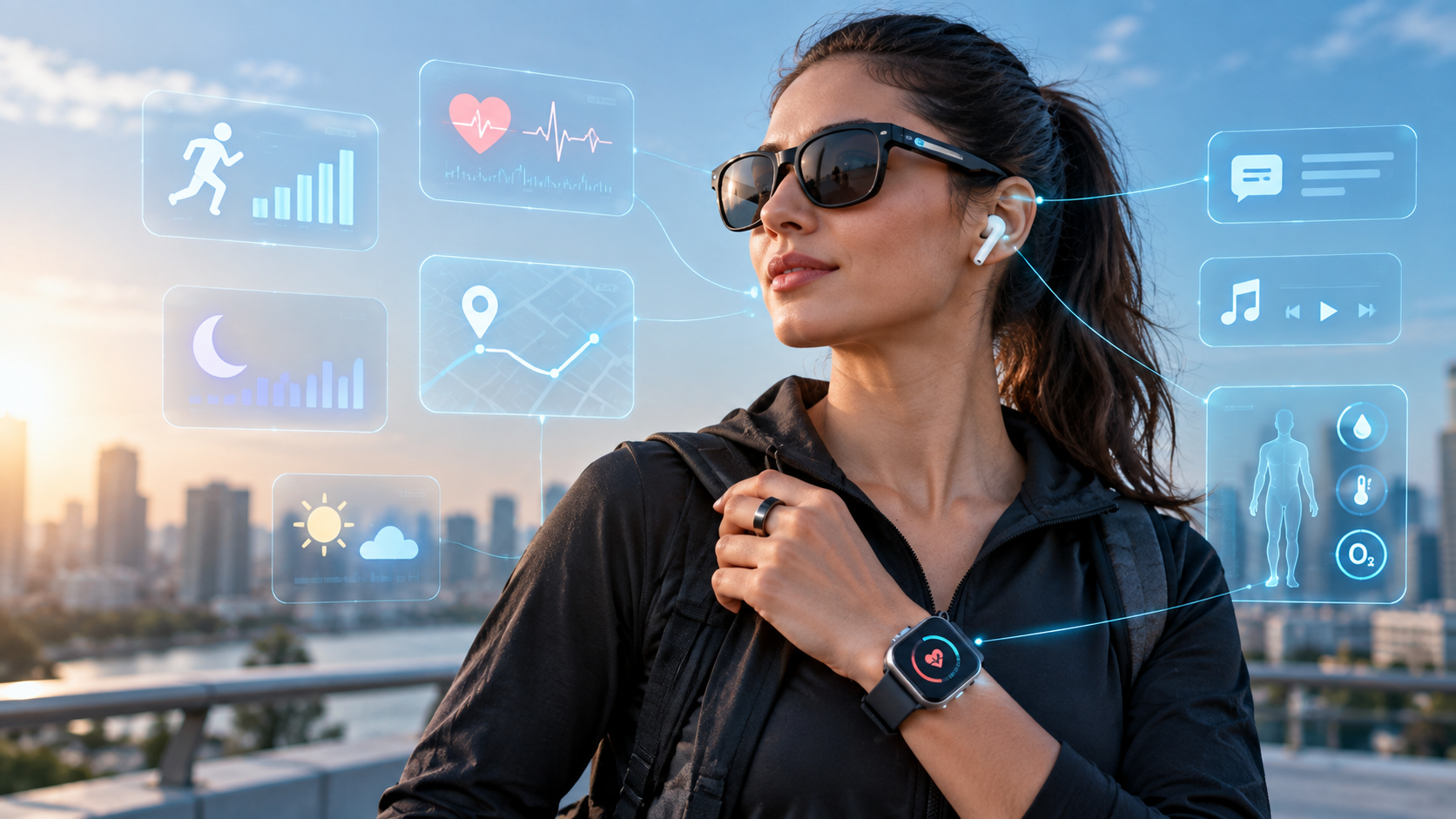
Wearable technology is technology designed to be worn on the body. It includes familiar devices such as smartwatches and fitness trackers, but the category is much broader. Smart rings, smart glasses, smart clothing, wireless earbuds, health-monitoring patches, and specialized workplace devices can all be considered wearable technology.
The main idea is simple: instead of keeping technology on a desk or holding it in your hand, wearable devices place electronic technology directly on or close to your body.
Many wearables use sensors to collect information about movement, location, activity, or certain body signals. The device can then process that information and display it to you or send it to a smartphone, computer, or online service.
So, what is wearable technology, how does it work, and why has it become so useful?
In this guide, you will learn what wearable technology means, how wearable devices work, the main types and examples, what they can track, where they are used, their benefits and limitations, accuracy and privacy concerns, costs, and what to consider before buying one.
What Is Wearable Technology?
Wearable technology refers to electronic devices that are designed to be worn on, attached to, or integrated with the human body or clothing.
A wearable device can contain several components, including:
- Sensors
- A processor
- Software
- A battery or another power source
- Wireless connectivity
- A display, speaker, vibration system, or other output method
For example, a smartwatch may use motion sensors to detect movement, optical sensors to estimate heart-related measurements, GPS to determine location, and Bluetooth to communicate with a smartphone.
Wearable technology is not limited to health and fitness. Depending on the device, it can be used for communication, navigation, entertainment, workplace safety, accessibility, sports, healthcare, and personal activity tracking.
ScienceDirect describes wearable technology broadly as products that can be worn on the body and combine computing with everyday activities, while research literature also highlights sensing, communication, data processing, privacy, security, and interoperability as important parts of the field.
What Makes a Device a Wearable?
Not every small electronic device is a wearable.
The defining feature is that the technology is designed to be worn or used directly on or close to the body.
For example:
- A smartwatch worn on the wrist is a wearable.
- A smart ring worn on a finger is a wearable.
- Smart glasses worn on the face are a wearable.
- A smartphone carried in your pocket is generally not considered a wearable.
- A smart TV is a connected device, but it is not wearable.
Wearable devices are particularly useful because they can remain close to the user while collecting information or providing quick access to digital services.
How Does Wearable Technology Work?
Although wearable devices come in many forms, most use a combination of sensors, processing, software, and connectivity.
A simple way to understand the process is:
Sensors → Data → Processing → Information → User
Here is what each stage means.
Sensors Collect Information
Sensors are a central part of many wearable devices.
They detect changes in the user’s movement, environment, or body and convert those changes into data that electronic systems can process.
Common wearable sensors include:
- Accelerometers: Detect movement and changes in speed.
- Gyroscopes: Help detect rotation and orientation.
- Optical sensors: Can be used for certain heart-related measurements.
- GPS: Determines location and movement routes.
- Temperature sensors: Measure temperature changes.
- Pressure sensors: Detect pressure or force.
- Microphones: Capture sound and support voice interaction.
- Biochemical sensors: In some advanced systems, detect specific substances or biological signals.
Wearable sensor systems can be used for physiological, movement-related, or environmental measurements.
The Device Processes the Data
Raw sensor data is not always meaningful on its own.
The device’s processor and software interpret the information and turn it into something the user can understand.
For example, a motion sensor does not literally count “steps” by itself. Software analyzes patterns in movement and uses those signals to estimate activity.
More advanced wearable systems can combine information from several sensors. This allows software to identify patterns that may not be visible from one sensor alone.
Wireless Connectivity Sends Information
Many wearables communicate with other devices through wireless technologies.
Bluetooth is commonly used to connect a wearable to a smartphone. Some devices can also use Wi-Fi or cellular connectivity.
This allows information collected by the wearable to be transferred to an application where it can be stored, displayed, analyzed, or synchronized.
Apps Turn Data Into Useful Information
The companion smartphone app is often an important part of a wearable system.
Instead of showing every piece of raw sensor information, the app may organize it into:
- Charts
- Trends
- Activity summaries
- Notifications
- Goals
- Historical records
- Personalized insights
This means the wearable itself is only one part of the overall system.
Common Examples of Wearable Technology
You probably already use or have seen wearable technology without thinking about it as a separate category.
Common examples include:
Smartwatches — Used for notifications, communication, activity tracking, navigation, and other functions.
Fitness trackers — Primarily designed to track activity, workouts, movement, and related measurements.
Smart rings — Small wearable devices that can track selected health, activity, or sleep-related information.
Smart glasses — Eyewear with electronic features such as cameras, speakers, microphones, displays, or connected services.
Wireless earbuds — Audio devices that can provide communication, voice controls, and other connected features.
Smart clothing — Clothing that incorporates sensors or electronic components into fabric or garments.
Medical wearables — Specialized devices designed to monitor particular physiological signals or support healthcare applications.
These examples show why wearable technology is such a broad category. Different devices can have completely different purposes while sharing the basic idea of technology designed to be worn.
Types of Wearable Technology
Smartwatches
Smartwatches are among the most recognizable wearable devices.
They combine the basic function of a watch with computing and communication features. Depending on the model, they can display notifications, handle calls and messages, track workouts, provide navigation, control music, and run applications.
Many smartwatches connect to smartphones, while some can use cellular networks independently for selected functions.
Their main advantage is convenience. Users can access certain information without constantly taking their phone out of their pocket.
Fitness Trackers
Fitness trackers are designed primarily for activity and exercise monitoring.
Common features include:
- Step tracking
- Distance estimates
- Workout tracking
- Activity goals
- Heart-related measurements
- Sleep-related tracking
- Calorie estimates
Fitness trackers are often simpler than full-featured smartwatches. This can make them suitable for people who mainly want activity information rather than a large collection of smartwatch features.
Smart Rings
Smart rings place electronic components and sensors inside a small ring.
Because they are much smaller than watches, they can be less noticeable while being worn.
Depending on the device, a smart ring may track activity, sleep, heart-related measurements, temperature changes, or other personal metrics.
However, features vary significantly between products, so consumers should check exactly what a particular ring measures rather than assuming all smart rings provide the same information.
Smart Glasses
Smart glasses add electronic features to eyewear.
Some models include cameras, microphones, speakers, voice controls, or connected services. More advanced systems may use displays to place digital information within the user’s field of view.
Potential applications include communication, navigation, entertainment, hands-free photography, workplace assistance, and augmented reality.
Smart glasses also introduce additional privacy considerations because cameras and microphones can affect people around the wearer.
Smart Clothing
Smart clothing, also known as electronic textiles or e-textiles, incorporates electronic components or sensors into clothing.
Examples can include smart shirts, sportswear, footwear, and other garments.
Research into smart textiles includes systems where sensors are attached to fabric as well as systems where electronic components are integrated into the textile itself. Future designs aim to make these systems more flexible, comfortable, and less noticeable.
Smart clothing has potential applications in sports, healthcare, workplace safety, and research.
Hearables
Hearables are wearable electronic devices designed to be worn in or around the ears.
Wireless earbuds are the most familiar example.
In addition to playing music, some connected earbuds can support calls, voice assistants, environmental controls, and other smart functions.
As more sensors and computing capabilities are added, the difference between ordinary audio equipment and wearable technology becomes less obvious.
Medical Wearables
Medical wearables are designed for healthcare or health-monitoring purposes.
They can include specialized patches, monitors, and other body-worn devices.
Some systems are designed to collect physiological information continuously or periodically and transfer it to another device or healthcare platform.
The capabilities of these products vary widely. A consumer fitness device should not automatically be treated as equivalent to a clinical medical device.
What Can Wearable Devices Track?
The information a wearable can collect depends on its sensors, software, and intended purpose.
Movement and Activity
Motion sensors can detect changes in movement and help estimate activity.
This information can support step counting, workout tracking, movement analysis, and other functions.
Location
Devices with GPS or other location technologies can track routes and outdoor movement.
This is useful for runners, cyclists, hikers, travelers, and people who want navigation features.
Heart-Related Measurements
Some wearables use optical or other sensing technologies to estimate heart-related information.
The exact measurement depends on the device.
It is important to remember that an estimate from a consumer wearable is not automatically equivalent to a measurement from specialized medical equipment.
Sleep
Many wearables use movement and other signals to estimate aspects of sleep.
They may provide information about sleep duration, nighttime movement, or patterns across multiple nights.
The greatest value may come from observing trends over time rather than treating one night’s data as a precise medical assessment.
Temperature and Other Signals
More advanced wearable sensors can monitor additional physical or environmental signals.
Research in wearable health sensors includes physical measurements such as pressure, strain, temperature, and motion, along with biochemical sensing technologies.
However, the availability of these features depends heavily on the device.
Where Is Wearable Technology Used?
Wearable technology is used in far more places than gyms and running tracks.
Health and Wellness
Health and wellness are major areas of wearable technology.
People use wearables to monitor activity, workouts, sleep patterns, and other personal measurements.
This information can help users understand their habits and observe changes over time.
However, wearable data should be treated as information rather than automatically as a diagnosis.
Sports and Fitness
Athletes and recreational users can use wearable devices to monitor training.
Depending on the device, they may track distance, pace, workout duration, movement, and heart-related measurements.
This can help users understand how they train and compare activity over time.
Communication
Smartwatches and other connected wearables can show notifications, messages, and incoming calls.
This can be useful when checking a phone would be inconvenient.
Navigation
GPS-enabled wearables can provide directions or record outdoor routes.
For runners and cyclists, this can be particularly convenient because the device can remain on the wrist while the user is moving.
Workplace Safety
Wearable technology can also be used in professional and industrial environments.
Specialized systems can potentially provide location information, safety alerts, environmental information, or hands-free access to instructions.
Wearables are also being researched for human motion analysis and industrial applications.
Accessibility
Wearable technology can offer alternative ways to interact with digital information.
For example, vibration, audio, voice commands, and visual displays can provide different forms of feedback.
The usefulness of a particular feature depends on the individual’s needs and the design of the device.
Entertainment
Wearables can also be used for music, photography, gaming, augmented reality, and other entertainment experiences.
Smart glasses and wireless earbuds are good examples of how wearable devices can bring digital content closer to the user.
Benefits of Wearable Technology
Convenient Access to Information
A wearable keeps useful information close to you.
Instead of reaching for your smartphone, you may be able to glance at your wrist or use a voice command.
Regular Data Collection
Because wearables stay with the user, they can collect information during normal daily activities.
This makes it possible to observe patterns rather than relying only on occasional manual measurements.
Fitness Tracking
Wearables make it easier to monitor workouts and activity.
Users can set goals, review previous activity, and observe changes over time.
Hands-Free Interaction
Wearables can allow users to access information while their hands are occupied.
This can be useful while exercising, working, driving in appropriate circumstances, or performing tasks where handling a phone is inconvenient.
Personalized Information
Wearable software can organize large amounts of data into understandable summaries and trends.
Instead of looking at raw sensor readings, users can receive information in a format that is easier to interpret.
Limitations and Disadvantages of Wearable Technology
Wearable technology also has limitations.
Privacy
Many wearables collect personal information.
Depending on the device, this may include activity patterns, location, health-related measurements, voice recordings, or other data.
Users should understand what information the device collects and how it is stored and shared.
Privacy and security are recognized as important challenges in wearable technology research.
Accuracy
Wearable measurements are not always perfectly accurate.
Results can vary depending on the sensor, device design, fit, movement, software algorithms, and measurement being taken.
This is especially important when people interpret wearable data as medical information.
Battery Life
Most electronic wearables need regular charging.
Devices with bright displays, GPS, cellular connectivity, or multiple active sensors may consume more power.
Battery life should therefore be considered before purchasing a wearable.
Cost
Prices can vary significantly.
A basic fitness tracker may be relatively inexpensive, while an advanced smartwatch, smart glasses, or specialized medical wearable may cost substantially more.
Some products also offer optional or required subscriptions for additional services.
Comfort
A wearable needs to be comfortable enough to use regularly.
A device that is too heavy, bulky, irritating, or inconvenient to charge may end up being used less often.
Compatibility
Not every wearable works equally well with every smartphone or operating system.
Always check compatibility before buying.
How Accurate Is Wearable Technology?
Accuracy is one of the most important questions surrounding wearable devices.
There is no universal accuracy level for all wearables because different devices measure different things using different sensors and algorithms.
A smartwatch may provide useful activity trends while still producing estimates that differ from specialized equipment.
For everyday use, consistency can sometimes be more useful than focusing on tiny differences in individual readings.
For example, if you use the same device every day, you can observe whether your activity or sleep patterns are changing over time.
However, when information could affect a medical decision, users should understand the device’s intended purpose and seek appropriate professional advice rather than relying solely on consumer wearable data.
Are Wearable Devices Safe and Private?
Safety and privacy are two separate issues.
From a physical perspective, users should follow the manufacturer’s instructions and stop using a device if it causes significant skin irritation, discomfort, or another problem.
Privacy is more complicated because wearables can collect information that is personal and sometimes sensitive.
Before using a wearable, check:
- What information it collects
- Which permissions the app requests
- Where your data is stored
- Whether information is shared with third parties
- How your account is protected
- Whether you can delete or export your data
- Whether location tracking can be disabled
Devices with cameras and microphones deserve additional consideration because they can potentially capture information about people other than the wearer.
Research into wearable systems continues to identify privacy, security, data processing, and interoperability as major areas that need attention.
How Much Does Wearable Technology Cost?
There is no standard price for wearable technology.
The cost depends on the type of device, brand, sensors, materials, software, and connectivity.
A simple fitness tracker may focus on basic activity information, while a premium smartwatch can include a display, GPS, cellular connectivity, apps, advanced sensors, and other features.
There can also be ongoing costs.
Some products may offer subscription-based services for additional analytics or features. Accessories such as replacement bands or chargers may also cost extra.
Instead of asking only, “How much does the device cost?” consider the total cost of ownership.
How to Choose the Right Wearable Device
The best wearable depends on what you actually need.
Start With Your Main Goal
Ask yourself why you want the device.
Do you want:
- Fitness tracking?
- Sleep tracking?
- Notifications?
- Navigation?
- Communication?
- Health monitoring?
- Hands-free access?
- Workplace features?
Once you know the main purpose, unnecessary features become easier to ignore.
Check Compatibility
Make sure the wearable works with your smartphone and preferred applications.
A device with excellent hardware may still be inconvenient if it does not work well with the ecosystem you already use.
Check Battery Life
If you want to wear the device continuously, battery life is important.
Think about how often you are willing to remove and charge it.
Consider Comfort
Look at the device’s size, weight, strap, material, and overall design.
If you plan to wear it while sleeping, comfort becomes even more important.
Review Privacy Controls
Read the manufacturer’s privacy information.
Check which permissions the app requests and whether you have control over location, health, microphone, camera, and other data.
Compare Total Cost
Look at both the purchase price and possible recurring costs.
A cheaper device with an expensive subscription may cost more over time than a device with a higher upfront price and no required subscription.
Wearable Technology vs. Traditional Smart Devices
Wearable technology is part of the larger connected-device ecosystem, but not every smart device is a wearable.
Consider the difference:
| Device | Usually Wearable? | Typical Purpose |
|---|---|---|
| Smartwatch | Yes | Fitness, communication, notifications |
| Fitness tracker | Yes | Activity and fitness |
| Smart ring | Yes | Health and activity tracking |
| Smart glasses | Yes | Communication, media, augmented reality |
| Wireless earbuds | Yes | Audio and communication |
| Smartphone | No | General computing and communication |
| Smart speaker | No | Voice control and home automation |
| Smart TV | No | Entertainment |
The key difference is physical integration with the user.
A wearable is designed to stay on or close to the body while performing its electronic function.
What Is the Future of Wearable Technology?
The future of wearable technology is likely to involve improvements in sensors, materials, software, connectivity, artificial intelligence, and power efficiency.
One important direction is making devices smaller and more comfortable.
Researchers are working on flexible and stretchable sensors, electronic textiles, skin-mounted systems, and other technologies that can fit the body more naturally.
Artificial Intelligence
AI can help analyze large amounts of sensor data.
Instead of simply showing raw measurements, future systems may become better at identifying patterns and presenting information in ways that are easier for users to understand.
More Advanced Health Monitoring
Wearable health sensors are being developed to measure both physical and biochemical signals.
Recent research includes wearable sensors for areas such as sweat, tears, saliva, skin-based measurements, temperature, pressure, strain, and motion.
These technologies are still developing, and research challenges include calibration, signal quality, clinical testing, battery life, data sharing, and privacy.
Smart Clothing
Clothing could become an important part of future wearable technology.
Instead of wearing a separate device, sensors could increasingly become part of shirts, shoes, sportswear, or other everyday garments.
Better Energy Solutions
Battery life remains a major limitation for small electronic devices.
Researchers are exploring energy-efficient electronics and methods of harvesting energy from movement or other sources to reduce dependence on conventional batteries.
More Seamless Technology
The long-term goal for many wearable systems is to make technology feel less like a separate gadget.
Instead of carrying a bulky device, users may eventually interact with technology through clothing, glasses, rings, skin-mounted electronics, or other unobtrusive systems.
However, future development will need to balance convenience with privacy, security, accuracy, comfort, energy consumption, and user control.
Common Mistakes When Using Wearable Technology
Buying a wearable is only the first step. How you use it also matters.
Avoid these common mistakes:
- Buying features you do not need
- Assuming every measurement is perfectly accurate
- Ignoring privacy settings
- Forgetting to check compatibility
- Focusing too much on a single day’s data
- Choosing a device that is uncomfortable
- Ignoring battery life
- Treating wearable data as a medical diagnosis
- Failing to update device software
- Sharing sensitive information without understanding how it is handled
A wearable is most useful when its information supports a specific goal.
Frequently Asked Questions
What is wearable technology in simple words?
Wearable technology is electronic technology designed to be worn on or close to the body. Common examples include smartwatches, fitness trackers, smart rings, smart glasses, wireless earbuds, smart clothing, and specialized health-monitoring devices.
What are examples of wearable technology?
Common examples include smartwatches, fitness bands, smart rings, smart glasses, wireless earbuds, smart clothing, and medical wearables.
Is a smartwatch wearable technology?
Yes. A smartwatch is a type of wearable technology because it is an electronic device designed to be worn on the body. It can combine communication, computing, sensing, fitness tracking, and other functions.
How does wearable technology work?
Wearables use sensors to collect information about movement, location, physical signals, or the surrounding environment. A processor and software analyze that information, and the results can be displayed on the device or transferred to a smartphone or other system.
What sensors are used in wearable devices?
Wearables can use accelerometers, gyroscopes, optical sensors, GPS, temperature sensors, pressure sensors, microphones, and other specialized sensors. The exact sensors depend on what the device is designed to measure.
Can wearable technology monitor health?
Some wearable devices can monitor or estimate certain health-related measurements. However, capabilities vary between products, and consumer wearable information should not automatically be treated as a medical diagnosis.
Are wearable devices accurate?
Accuracy varies by device and measurement. Factors such as sensor design, device placement, movement, fit, and software algorithms can affect results. Wearable data can be useful for tracking trends, but it should be interpreted according to the device’s intended purpose.
Are wearable devices safe?
Wearable devices are designed for use on or around the body, but users should follow manufacturer instructions and pay attention to discomfort or skin irritation. Privacy and data security are also important because many wearables collect personal information.
Conclusion
So, what is wearable technology?
Wearable technology is a broad category of electronic devices designed to be worn on or close to the body. Smartwatches, fitness trackers, smart rings, smart glasses, wireless earbuds, smart clothing, and specialized health devices are all examples.
What makes wearables different from ordinary electronics is their close connection with the user. Sensors can collect information about movement, location, activity, or certain physical signals, while processors and software turn that information into useful data.