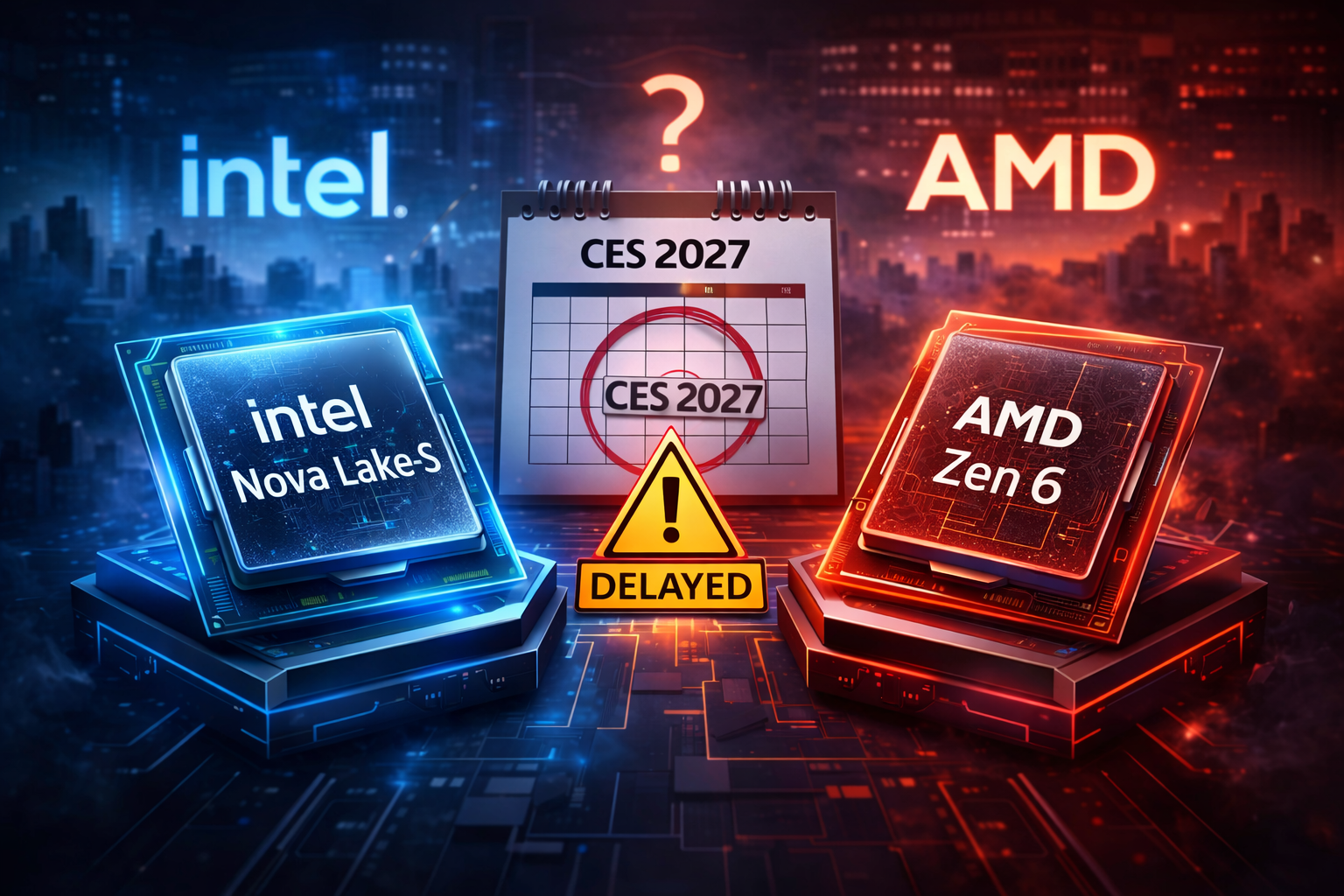
If you’ve been holding off on building a new PC, waiting for the next big leap in processor technology — you’re not alone. Millions of enthusiasts, content creators, and gamers had circled 2026 on their calendars, expecting Intel’s Nova Lake and AMD’s Zen 6 to shake up the market in a big way.
Well, it looks like that wait just got longer.
Fresh reports from well-known hardware leakers and industry publications now suggest that both Intel Nova Lake-S and AMD Zen 6 desktop CPUs won’t be landing on store shelves until 2027 — likely debuting at CES 2027 in January of that year. This isn’t just a minor slip on a roadmap. For many buyers, it changes their entire upgrade strategy.
So what’s causing these delays? What do we actually know about these chips? And most importantly — what should you do while you wait? Let’s break it all down.
What Are Intel Nova Lake and AMD Zen 6, Anyway?
Before we get into the why, it helps to understand what exactly is being delayed — and why people care so much.
Intel Nova Lake-S: A Bold Reinvention
Nova Lake-S is Intel’s next-generation desktop processor platform, set to replace the current Arrow Lake lineup (Core Ultra 200 series). This isn’t just an incremental refresh. Nova Lake-S is expected to bring one of the biggest architectural changes Intel has made in years.
Here’s what’s reportedly on the table:
Intel is planning a new LGA1954 socket, which means anyone upgrading will need a new motherboard. That’s a big deal, but the specs seem to justify it. The top-tier Core Ultra 9 chips are expected to pack up to 52 CPU cores across two compute tiles, with 16 P-Cores, 32 E-Cores, and 4 low-power E-Cores. Even the mid-range Core Ultra 7 would offer 14 P-Cores and 24 E-Cores — more cores than today’s flagship processors.
One of the most exciting features is Intel’s bLLC (Big Last Level Cache) technology. Think of it as Intel’s answer to AMD’s popular 3D V-Cache — a large on-die cache designed to dramatically improve gaming performance by keeping more frequently used data close to the processor. Top-end Nova Lake chips could carry up to 144MB of L3 cache per compute tile.
That said, there’s a catch. Power consumption figures being thrown around are staggering — reportedly over 700 watts for flagship models. That’s going to require seriously robust cooling and premium power delivery setups. It’s an unusual choice for a consumer product, but Intel appears to be going all-in on raw performance.
AMD Zen 6 “Olympic Ridge”: More Cores, Same Trusted Platform
AMD’s Zen 6 desktop processors, codenamed “Olympic Ridge,” represent the next major step forward for the Ryzen family. AMD is reportedly increasing the core count per chiplet from 8 to 12, which would push the top-end Ryzen 9 desktop CPUs to 24 cores — a 50% jump over today’s best offerings.
The good news for existing AMD users is that Zen 6 is expected to stick with the AM5 socket, meaning your current 600-series or 800-series motherboard might remain compatible. AMD has historically offered better platform longevity than Intel, and Zen 6 appears to continue that tradition.
Zen 6 is also expected to benefit from a next-generation manufacturing process, delivering better power efficiency and higher clock speeds compared to Zen 5. For gamers, the question will be whether AMD continues its dominance with X3D variants — and all signs point to yes.
Why Are They Delayed? The Real Story Behind the Push back
This is where things get interesting. The delay isn’t simply about engineering challenges. There are several industry-level forces pushing these launches back, and understanding them helps explain why both companies landed in the same place at roughly the same time.
The AI Boom Is Eating Everyone’s Lunch
Both Intel and AMD are feeling the pressure of the AI infrastructure gold rush. Data centers and cloud providers are throwing enormous amounts of money at server-grade hardware — GPUs, AI accelerators, and high-performance server CPUs — and chip manufacturers are following the money.
Intel has openly stated that it is shifting production capacity toward its data center Xeon lineup to meet surging enterprise demand. In the company’s Q4 and Full-Year 2025 financial report, CFO David Zinsner acknowledged that Intel is moving as much production as possible to the data center side. When you’re prioritizing server chips, consumer desktop chips naturally move down the queue.
AMD faces a similar dynamic. The company is producing Zen 6 cores for its EPYC “Venice” server processors first — which is standard practice. Data center launches typically precede consumer releases, but the current AI frenzy appears to have extended that gap significantly, pushing the desktop Ryzen launch well beyond initial estimates.
The DRAM Crisis Is Making Things Worse
If AI demand isn’t enough, the PC industry is also navigating a significant memory market disruption. DRAM prices have been climbing sharply, SSDs are getting more expensive, and the broader component landscape is in flux.
This creates a tricky situation for CPU manufacturers. Releasing a brand new platform — especially one requiring new motherboards, new memory configurations, and premium cooling — into a market where consumers are already stretched thin is a risky move. Delaying a launch can be a smart business decision when the market conditions aren’t right for it.
Think about it from a buyer’s perspective: if RAM prices are through the roof and you’d also need a new motherboard and a stronger PSU, you might decide to wait. Lower-than-expected sales at launch would be a PR headache neither company wants to deal with.
Intel Has Bigger Fish to Fry: The 18A Process
For Intel specifically, there’s another layer to this story. The company is deep in the development and validation of its Intel 18A manufacturing process — its most advanced chipmaking technology to date, and arguably the most important thing Intel has to prove to the world right now.
Intel has been on a difficult journey over the past few years, losing process node leadership to TSMC. Getting 18A right is existential for Intel’s foundry business and its long-term competitiveness. Diverting engineering focus and production resources toward getting Nova Lake out the door on time could compromise 18A — and that’s a trade-off Intel clearly isn’t willing to make.
What Does the CES 2027 Timeline Actually Look Like?
The current expectation, based on multiple leakers and industry sources, is that both Intel Nova Lake-S and AMD Zen 6 desktop CPUs will be unveiled at CES 2027, scheduled for January of that year.
However, there’s an important nuance here. An announcement at CES doesn’t always mean immediate availability. There’s a reasonable chance that what we see at CES 2027 is a formal reveal with retail launches following in Q1 or Q2 2027. We’ve seen this pattern before — companies love the spotlight of a major tech show but often need weeks or months before products actually hit the market.
There is also a small possibility that early Nova Lake variants could quietly appear in Q4 2026, with the full desktop lineup rolling out at CES 2027. Intel has hinted at a “late 2026” timeline internally, so a quiet launch for select SKUs before a bigger announcement in January remains on the table.
For AMD, the path seems clearer. Zen 6 for servers (EPYC Venice) is expected to arrive in late 2026 as planned. The desktop Ryzen version under Olympic Ridge would then follow in early 2027.
What This Means for PC Builders and Buyers Right Now
If you’re sitting on an older system and trying to decide whether to upgrade today or hold out — here’s some practical perspective.
If you have a system from 2020 or earlier, particularly something built around 10th/11th Gen Intel or AMD Ryzen 3000/4000, you’re likely feeling the performance gap. Waiting until 2027 might be too long. The current generation — AMD Ryzen 9000 series and Intel Core Ultra 200 — offers meaningful improvements that will serve you well for years.
If you’re already on a Ryzen 7000 or Ryzen 9000 system, or even an Intel 13th/14th Gen machine, the honest answer is: you don’t need to do anything right now. These are capable platforms. Waiting for Zen 6 or Nova Lake makes real sense at this stage, especially since you’re not losing much by waiting a few more months into 2027.
If you’re eyeing a gaming-focused build, it’s worth knowing that the current AMD Ryzen 9 9800X3D remains one of the best gaming CPUs ever made. Pairing it with a strong GPU will get you excellent results well into 2027 and beyond.
For content creators and professionals who rely on high core counts for rendering, video editing, or simulation workloads, the jump to Zen 6 or Nova Lake could be substantial. Waiting makes sense if your current setup is still getting the job done.
The Silver Lining: A Historic Head-to-Head Battle in 2027
Here’s something genuinely exciting buried in this news. Because both Intel and AMD are now targeting the same launch window, we could be looking at the most competitive next-gen CPU launch in recent memory.
In most product cycles, one company launches first and has weeks or months of uncontested market presence. The other plays catch-up in reviews and benchmarks. If both companies debut their flagship desktop chips within the same CES 2027 window, we’ll get direct comparisons from day one — real-world benchmarks, gaming tests, productivity workloads, power efficiency numbers — all side by side, right out of the gate.
For consumers, that kind of competition is almost always good news. It pushes both companies to sharpen their pricing, maximize performance, and offer better value. If AMD’s X3D V-Cache continues to lead in gaming and Intel’s bLLC makes a genuine challenge, the rivalry could reach a new intensity that benefits everyone.
Conclusion: Stay Patient, Stay Informed
The delay of Intel Nova Lake and AMD Zen 6 to 2027 is genuinely disappointing for anyone who had been counting on a mid-cycle upgrade this year. But the reasons behind it — AI-driven production shifts, a challenging DRAM market, and Intel’s focus on long-term manufacturing competitiveness — make rational sense when viewed from the companies’ perspectives.
The silver lining is that what’s coming in 2027 is shaping up to be something special. More cores, massive cache improvements, new architectures, and a head-to-head showdown that the industry hasn’t seen in years.
For now, the smartest move is to assess your actual needs. If your current PC is holding you back today, upgrade today. If it’s still running strong, sit tight — 2027 is closer than it sounds, and it might just be worth the wait.
FAQ: Intel Nova Lake and AMD Zen 6 Delay
Q: Why are Intel Nova Lake and AMD Zen 6 being delayed to 2027? A: The main reasons include a shift in production capacity toward AI and data center chips, an ongoing DRAM market crisis driving up component prices, and Intel’s strategic focus on its next-generation 18A manufacturing process. Both companies appear to be waiting for better market conditions to launch premium consumer products.
Q: Will Nova Lake-S require a new motherboard? A: Yes. Intel’s Nova Lake-S is expected to use a new LGA1954 socket, which means existing motherboards will not be compatible. Users upgrading from Arrow Lake or older platforms will need to purchase a new board.
Q: Will AMD Zen 6 work with existing AM5 motherboards? A: Current leaks suggest AMD is maintaining AM5 socket compatibility with Zen 6, which would allow users with 600-series and 800-series motherboards to potentially upgrade without replacing their board. However, this has not been officially confirmed by AMD.
Q: When exactly will Intel Nova Lake and AMD Zen 6 launch? A: Based on current reports, both are expected to be unveiled at CES 2027 in January 2027. Retail availability could follow in Q1 or Q2 2027, though final dates have not been officially confirmed by either company.
Q: Should I upgrade my PC now or wait for Nova Lake and Zen 6? A: It depends on your current system. If you’re on a 2019 or older build, upgrading now with current-gen hardware makes sense. If you’re on a Ryzen 7000/9000 or Intel 13th/14th Gen system, your PC is already capable and waiting for 2027 is a reasonable option.
Q: What is Intel’s bLLC cache and how does it compete with AMD’s 3D V-Cache? A: Intel’s bLLC (Big Last Level Cache) is a large integrated cache built directly into the compute tile design of Nova Lake chips, reportedly offering up to 144MB per tile. AMD’s 3D V-Cache physically stacks extra cache on top of the CPU chiplet. Both aim to improve gaming performance by reducing memory latency, and both will likely compete head-to-head in 2027 benchmarks.
Q: How many cores will Zen 6 and Nova Lake offer? A: Leaked information suggests Zen 6 desktop CPUs will feature up to 24 cores (12 per chiplet, dual chiplet design), while Nova Lake-S flagship models could offer up to 52 cores across two compute tiles with a mix of P-Cores, E-Cores, and low-power E-Cores.
Q: Is the delay official or just based on leaks? A: As of now, neither Intel nor AMD has officially confirmed a delay of desktop consumer CPUs to 2027. The information comes from well-known and reliable hardware leakers including Golden Pig Upgrade on Weibo and publications like Bench life and Tom’s Hardware. Treat the timeline as highly likely, but not yet confirmed.