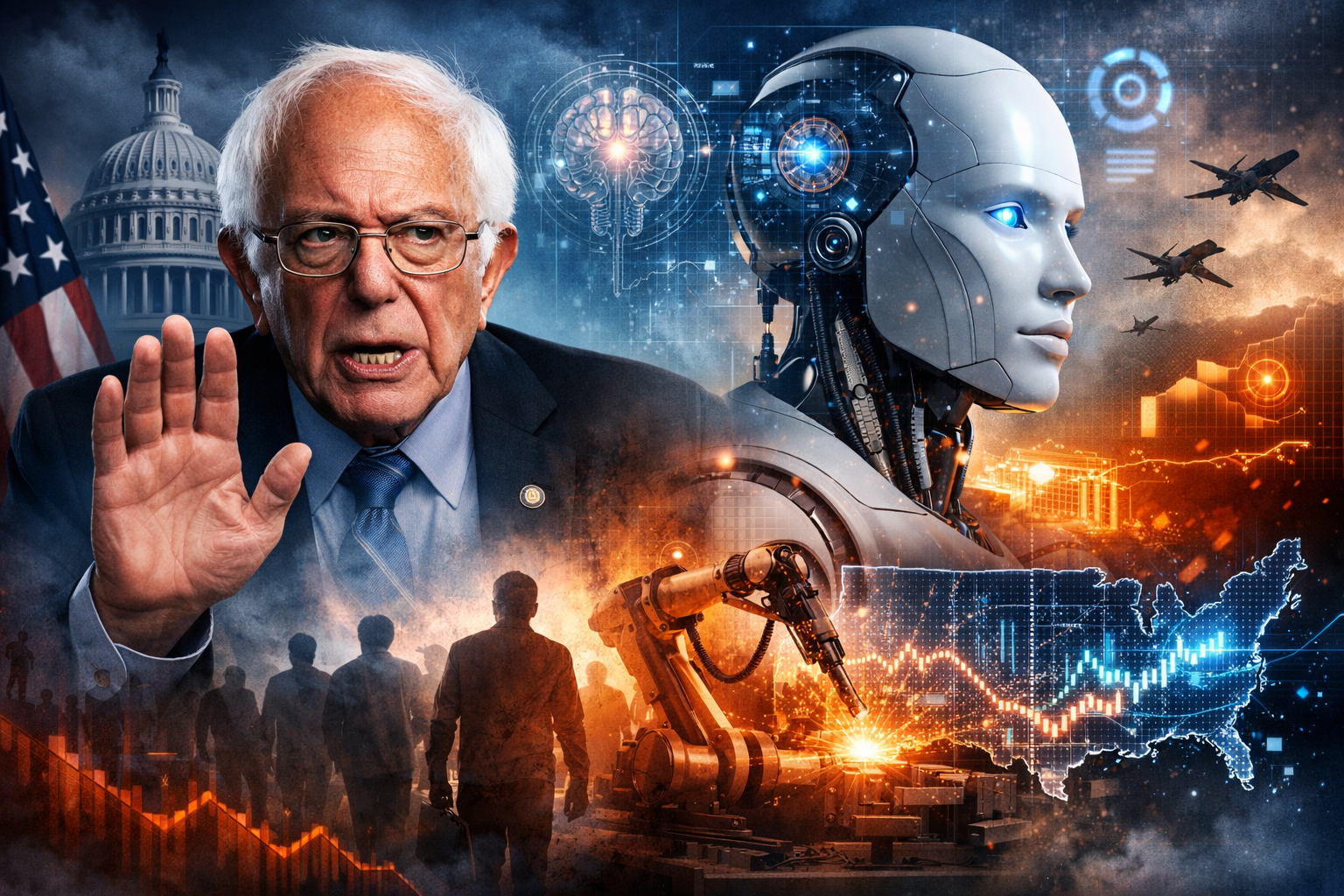
Artificial intelligence is no longer a futuristic concept — it is rapidly reshaping the global economy. As AI systems become more advanced and widely adopted, concerns about regulation, job losses, economic inequality, and national security are intensifying. Senator Bernie Sanders has issued a stark warning, arguing that the United States has little understanding of how fast and how dramatically artificial intelligence will transform society.
His message is direct: slow this thing down before the consequences spiral out of control.
The AI Revolution Is Moving Faster Than Expected
The growth of artificial intelligence has accelerated dramatically over the past few years. From generative AI tools that create text, images, and code to machine learning systems driving automation across industries, the speed of innovation is unprecedented.
Unlike previous technological revolutions — such as the industrial era or the rise of the internet — AI development is scaling globally within months. New models are released, upgraded, and integrated into businesses at lightning speed. Companies are investing billions into AI infrastructure, racing to dominate the emerging market.
According to Sanders, policymakers are not keeping pace. Federal regulation remains fragmented while private companies move aggressively to deploy powerful AI systems without comprehensive oversight.
Why Sanders Says the US Is Unprepared
Sanders argues that the United States lacks a clear national strategy for managing the AI revolution. While innovation can drive economic growth, unregulated expansion could produce serious risks.
Key concerns include:
-
Massive workforce disruption
-
Increased wealth inequality
-
Corporate concentration of power
-
Data privacy violations
-
National security threats
-
AI-driven misinformation
The warning is not about halting technological progress. Instead, it is about ensuring that AI development benefits the broader population rather than concentrating power among a few dominant tech corporations.
AI and the Future of American Jobs
One of the most urgent issues surrounding artificial intelligence is job displacement. Automation has already reshaped manufacturing and logistics industries. However, AI now threatens white-collar professions that were once considered secure.
Industries potentially affected include:
-
Journalism
-
Customer service
-
Graphic design
-
Legal research
-
Accounting
-
Software development
-
Administrative roles
While AI may create new job categories, the transition could be disruptive. Millions of workers may require retraining, yet large-scale reskilling programs are not fully prepared to handle sudden shifts in employment.
Sanders emphasizes that without federal protections and worker-centered policies, corporations may accelerate automation primarily to maximize profits, leaving workers vulnerable.
Wealth Inequality in the Age of AI
Another major concern is economic inequality. The AI revolution is largely driven by massive technology companies with access to vast computing resources and proprietary data. As AI systems become more efficient, corporate profits could skyrocket.
If left unchecked, this concentration of technological power could widen the gap between billion-dollar tech firms and ordinary workers. Sanders has consistently advocated for stronger labor rights, progressive taxation, and corporate accountability. In the AI context, he argues that policies must prevent extreme wealth concentration and ensure shared economic benefits.
Without regulation, the AI boom could disproportionately reward investors and executives while reducing job security for millions.
National Security and Ethical Challenges
Artificial intelligence also presents serious national security and ethical concerns. Advanced AI systems can be weaponized for cyberattacks, surveillance, deepfake misinformation, and automated warfare technologies.
Critical questions remain unanswered:
-
How safe are advanced AI systems?
-
Who monitors corporate AI development?
-
How transparent are decision-making algorithms?
-
What safeguards prevent bias and discrimination?
The rapid development of AI tools capable of generating realistic fake content has already raised alarms about election integrity and public trust. Sanders warns that without clear federal standards and international cooperation, the risks could escalate quickly.
The Case for Stronger AI Regulation
Sanders’ call to “slow this thing down” highlights the need for responsible governance. A balanced approach would not stop innovation but would ensure that safety, fairness, and worker protections are prioritized.
Potential regulatory actions may include:
-
Mandatory AI safety testing
-
Transparency requirements for AI systems
-
Federal investment in workforce retraining
-
Stronger data privacy protections
-
Tax policies addressing AI-driven corporate gains
-
Oversight boards to monitor AI deployment
Currently, AI regulation in the United States remains under development. Lawmakers are debating proposals, but comprehensive national AI legislation has yet to fully match the scale of technological advancement.
Can the US Balance Innovation and Protection?
The United States faces a difficult challenge. Moving too slowly could risk falling behind global competitors in AI research. Moving too quickly without safeguards could create economic instability and ethical crises.
Sanders’ warning reflects a broader debate about the role of government in shaping emerging technologies. Should AI development be primarily driven by private corporations, or should stronger public oversight guide its evolution?
The answer may determine whether artificial intelligence becomes a tool for shared prosperity or a driver of deeper social inequality.
The Road Ahead
Artificial intelligence will continue to evolve at extraordinary speed. Businesses, governments, and individuals must adapt to a rapidly changing technological landscape.
To ensure long-term stability and fairness, experts emphasize:
-
Investment in education and digital skills
-
Large-scale workforce retraining programs
-
Ethical AI research and development
-
Clear regulatory frameworks
-
International cooperation on AI governance
The AI revolution is not optional — it is already underway. The key question is whether policymakers can respond quickly enough to manage its impact.
Conclusion
Artificial intelligence promises enormous economic growth, innovation, and productivity gains. However, it also carries significant risks if deployed without thoughtful oversight. Senator Bernie Sanders’ warning serves as a reminder that technological progress must be matched with responsible governance.
“Slow this thing down” is not an attempt to stop innovation. It is a call for strategic planning, worker protection, and ethical safeguards.
As the AI revolution accelerates, the United States stands at a crossroads. The decisions made today will shape the future of work, economic equality, and national security for decades to come.