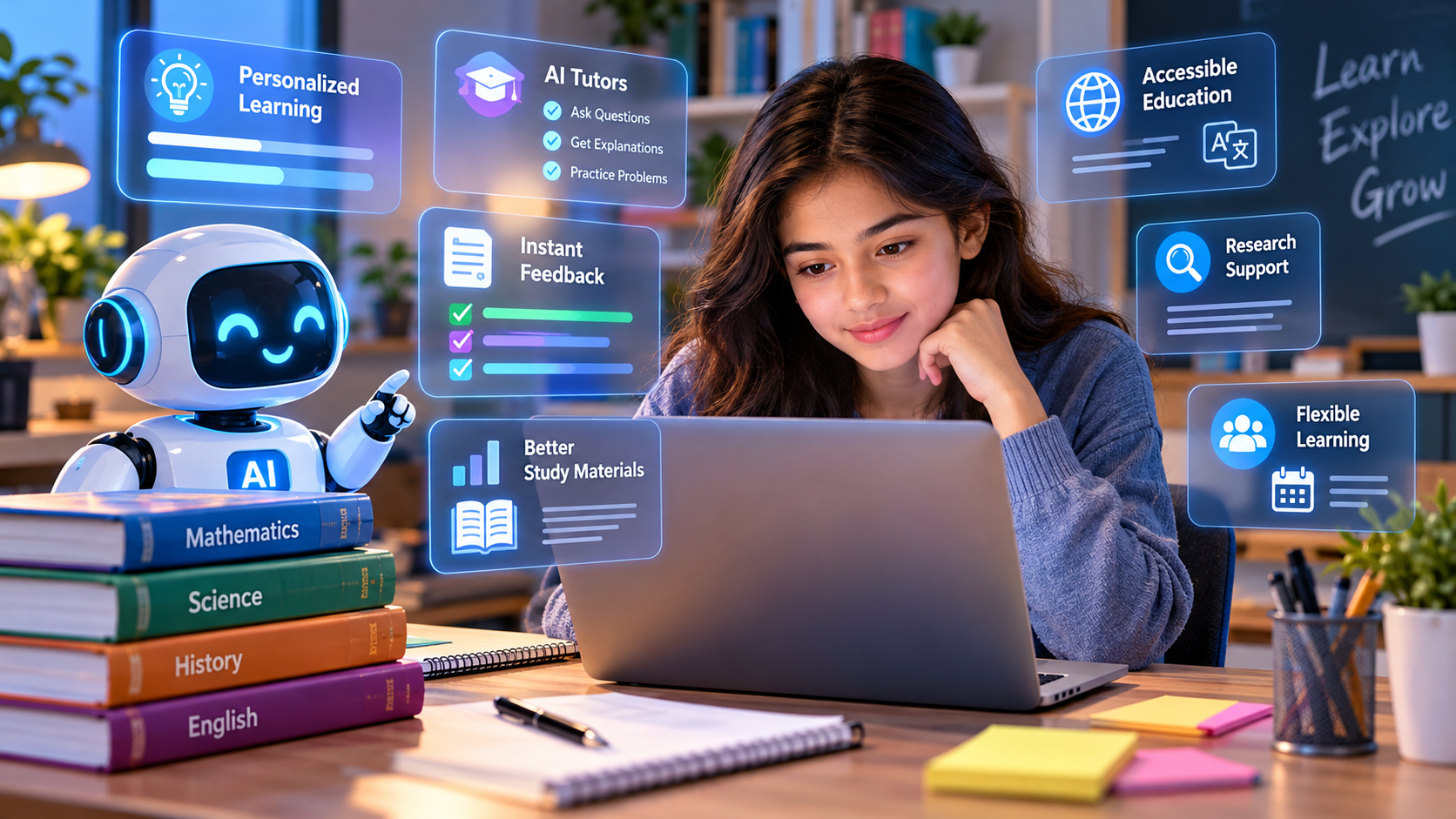
Artificial intelligence (AI) is changing the way students study, understand difficult subjects, and prepare for exams. From personalized lessons to instant feedback, AI tools are giving students more ways to learn at their own pace. Instead of spending hours trying to understand one difficult topic, students can now ask questions and get explanations in seconds.
But AI in education is not just about getting quick answers. It is also changing how students do research, complete assignments, prepare for tests, and find information. When used properly, AI can make learning easier and more flexible. At the same time, using it too much can create problems, especially when students start depending on it for every task.
For students, teachers, and parents, understanding these changes is becoming increasingly important. AI can be a helpful learning partner, but students still need to think for themselves and develop their own skills.
What Is AI in Education?
Artificial intelligence refers to computer systems that can perform tasks such as understanding language, recognizing patterns, generating content, and solving certain problems. In education, these systems can help students study, support teachers, and make learning materials easier to understand.
For example, a student who struggles with mathematics can ask an AI tool to explain a problem step by step. Someone studying biology can request a simple explanation of a complicated process or create practice questions before an exam.
Some AI learning platforms can also analyze a student’s answers and suggest additional exercises. This helps students focus on the topics they find difficult instead of spending the same amount of time on everything.
However, AI does not always provide correct information. Students should use it as a learning assistant rather than trusting every answer without checking it.
Personalized Learning for Every Student
Every student learns differently. Some understand a topic after one explanation, while others need more examples and practice. In a traditional classroom, teachers have to manage these different learning needs at the same time.
AI-powered learning tools can make this process more flexible. They can provide explanations and exercises based on a student’s current level of understanding. If a student keeps making mistakes in algebra, for example, an AI tool may suggest easier questions and explain the basic rules again.
Students who already understand the material can move on to more challenging exercises. This allows learners to spend more time on the areas where they actually need help.
Personalized learning can help students identify their weaknesses, review difficult lessons, and track their progress. It also gives them the freedom to study at a comfortable pace without feeling rushed.
Still, these tools are only helpful when their recommendations are accurate. Students should regularly check their progress and ask teachers for help when a topic remains confusing.
AI Tutors Provide Extra Help to Students
Sometimes students have questions after school but cannot get immediate help from a teacher. They might be doing homework late at night or preparing for an exam and suddenly get stuck on a difficult question.
AI tutors can provide additional support in these situations. Students can ask questions, request examples, and get explanations whenever they need help.
For example, someone learning English can use AI to practice grammar, improve vocabulary, and create simple conversations. A science student can ask for an explanation of a difficult concept before going back to the textbook.
One useful thing about AI tutors is that students can ask the same question several times without feeling embarrassed. They can also request simpler explanations if the first answer is too complicated.
However, AI tutors are not perfect replacements for human teachers. Teachers understand their students, notice when someone is struggling, and can provide personal guidance that a computer tool may not be able to offer.
Faster Feedback Helps Students Improve
Getting feedback is an important part of learning. When students understand their mistakes, they have a better chance of avoiding them in the future.
Normally, students may have to wait for a teacher to check their assignments before finding out what went wrong. AI tools can provide feedback on certain writing tasks, grammar exercises, quizzes, and mathematical problems much faster.
For example, a student writing an essay can use an AI assistant to find repeated words, unclear sentences, or grammar problems. The student can then review the suggestions and improve the original work.
The real benefit comes when AI explains why something needs to be changed. Simply replacing a student’s answer with a better one does not always help them learn.
Teachers can also use AI-supported tools to identify common mistakes and understand which topics need more attention in the classroom.
Creating Better Study Materials With AI
Preparing for exams can be stressful, especially when students have several subjects to revise at the same time. Reading long chapters, organizing notes, and remembering important information takes a lot of effort.
AI can help students create study materials that make revision more organized. Depending on the tool, students can generate summaries, flashcards, practice quizzes, essay outlines, and questions based on their lessons.
Imagine a student preparing for a history exam with several chapters to cover. They can organize their notes by topic and create practice questions to test their knowledge. After answering the questions, they can review their mistakes and focus on the areas that need more work.
This is more useful than just reading the same notes again and again. Testing yourself helps you discover what you actually remember.
However, students should not depend completely on AI-generated notes. Sometimes a summary misses important details or gives an incomplete explanation. Checking the original textbook and class notes is still necessary.
Making Education More Accessible
AI is also helping some students overcome learning barriers. Translation tools, speech recognition, text-to-speech applications, and simplified explanations can make educational resources easier to understand.
Students who speak a different first language can use translation tools to understand unfamiliar words. Those who prefer listening may benefit from applications that read digital text aloud. Speech-to-text tools can also help convert spoken answers into written form.
These features can make studying more convenient for learners with different needs. They may also provide additional support to students who do not have access to private tutors or other educational resources.
However, access to AI is not equal for everyone. Some students have reliable internet connections, modern computers, and paid subscriptions, while others have to manage with limited resources.
Schools should consider these differences when introducing AI into classrooms. Technology should help students access better learning opportunities, not create another barrier for those who cannot afford it.
How AI Is Changing Research and Writing
Research and writing are important parts of education because they teach students how to find information, understand evidence, and explain their own ideas.
AI can help students brainstorm topics, organize their thoughts, explain unfamiliar terms, and create outlines for assignments. For example, a student researching environmental issues can ask AI for possible research questions and explanations of scientific concepts.
But this should only be the starting point. Students still need to read reliable sources, compare information, and decide which evidence supports their arguments.
One major problem with AI-generated content is that it can include incorrect facts or references that do not exist. Students should always check the original sources before using information in academic work.
There is also a difference between getting help with an assignment and allowing AI to do all the work. If students submit content they do not understand, they may finish the task without learning the skills it was designed to teach.
Using AI responsibly means following school rules, acknowledging assistance when required, and making sure the final work reflects your own understanding.
The Role of AI in Supporting Teachers
AI is not only changing the student experience. It is also helping teachers manage some of their everyday responsibilities.
Teachers often spend hours preparing lessons, creating exercises, checking assignments, and adjusting materials for students with different abilities. AI tools can help with some of these tasks by generating quiz questions, suggesting examples, and preparing revision materials.
For instance, a teacher preparing a lesson about ecosystems could use AI to create a short quiz and a list of important terms. The teacher can then check the material and make changes before sharing it with the class.
AI tools may also help teachers notice patterns in student performance. If several students struggle with the same question, the teacher can review the lesson and explain the topic in a different way.
However, teachers still need to check AI-generated content carefully. A tool may provide outdated information, misunderstand a question, or produce materials that are not suitable for a particular class.
AI works best when it supports teachers rather than making educational decisions without human supervision.
The Challenges of Using AI in Education
Although AI offers many benefits, it also comes with some challenges that students and teachers should understand.
One major concern is incorrect information. AI tools can sometimes provide answers that sound convincing but are actually wrong. Students who are unfamiliar with a subject may find it difficult to recognize these mistakes.
Another problem is overdependence. If students use AI to complete every assignment, solve every problem, and write every paragraph, they may not develop their own problem-solving and writing skills.
Academic integrity is another important issue. Schools and universities have different rules about AI use in assignments and examinations. Students should understand these rules before using AI to complete academic work.
Privacy also matters. Students should avoid sharing passwords, personal records, confidential school documents, or other sensitive information with unapproved AI services.
Finally, not every student has the same access to technology. Reliable internet, suitable devices, and paid tools can make a difference in the learning experience. Educational institutions should consider these challenges before making AI an essential part of their teaching methods.
AI Learning Tools Compared With Traditional Learning
AI-supported learning and traditional education both have their own advantages.
AI tools can provide quick explanations, extra practice, and flexible access to learning materials. Students can revisit a difficult topic as many times as needed and get help outside regular classroom hours.
Traditional education offers something different. Teachers can build relationships with students, encourage classroom discussions, understand emotional needs, and provide guidance based on personal experience.
Neither method is perfect on its own. AI can make additional practice easier, while teachers can help students understand complex ideas and develop important social skills.
Combining both approaches often makes more sense than choosing one over the other. Students can use AI for revision and practice while relying on teachers and trusted educational resources for deeper understanding.
How Students Can Use AI Effectively
Students do not need complicated methods to get useful results from AI. A few simple habits can make a big difference.
First, identify what you want to learn before opening an AI tool. You might need help understanding a concept, preparing for an exam, or organizing your notes.
Second, ask for explanations instead of simply requesting answers. For example, you can ask an AI assistant to explain an algebra problem step by step and then give you three similar questions to solve on your own.
Third, test your knowledge regularly. Ask for a short quiz, answer the questions without looking at your notes, and review any mistakes. This will help you understand which topics need more practice.
Fourth, verify important facts using textbooks, reliable websites, academic publications, or guidance from your teacher. Never assume that every AI-generated answer is correct.
Finally, keep practicing without AI. Reading, writing, solving problems, and remembering information independently are still essential parts of learning.
Students should also follow their school’s policies and disclose AI assistance whenever required.
The Future of AI in Education
AI-powered learning tools are likely to become more interactive and easier to use. Students may increasingly have access to systems that combine text, voice, images, and practice exercises to explain difficult topics.
For example, language learners could practice conversations with AI, while science students could use interactive visual materials to understand complicated processes. Teachers may also use these tools to prepare lessons and identify areas where students need additional support.
However, better technology does not automatically mean better education. Schools will need clear policies, teacher training, privacy protections, and ways to check whether AI tools actually help students learn.
The most useful developments will be those that help students understand concepts, practice important skills, and become more confident independent learners.
Frequently Asked Questions
How is AI changing the way students learn?
AI is helping students access personalized explanations, practice questions, instant feedback, and flexible study materials. It can provide additional learning support outside classroom hours and help students focus on difficult topics.
What are the main benefits of AI in education?
The main benefits include personalized learning, quick feedback, extra tutoring support, easier study-material creation, improved accessibility, and help with research and revision.
Can AI replace teachers?
AI can assist with certain educational tasks, but it cannot fully replace teachers’ professional judgment, personal relationships, emotional support, and classroom experience. It is best used as a tool that supports teachers and students.
What are the disadvantages of AI for students?
The main disadvantages include incorrect information, overdependence on technology, privacy concerns, academic integrity problems, and unequal access to digital resources. Responsible use can help reduce these risks.
How can students use AI without cheating?
Students can use AI to understand concepts, generate practice questions, organize revision schedules, and receive feedback where permitted. They should follow school rules, verify information, and make sure their submitted work reflects their own understanding.
Does AI improve student learning?
AI can support learning when it is used with clear goals and effective teaching methods. However, completing assignments faster does not necessarily mean students have learned more. Independent practice and critical thinking remain essential.
Conclusion
Artificial intelligence is changing how students study, find information, receive feedback, and prepare for exams. It offers new ways to make learning more flexible, personalized, and accessible.
At the same time, students should not let technology do all the thinking for them. They still need to ask questions, check facts, solve problems independently, and develop their own ideas. Teachers also remain important in guiding students and helping them use AI responsibly.Read More about