A robot that can walk, pick up an object, understand an instruction, and move through a workplace designed for humans sounds like science fiction. Yet that is increasingly becoming an engineering project rather than a movie concept.
Humanoid robots are being developed for manufacturing, logistics, research, healthcare support, and eventually household tasks. Advances in artificial intelligence, computer vision, sensors, batteries, actuators, and robotic control are allowing machines to perform increasingly complex physical actions.
The technology is still developing. Most humanoid robots can’t reliably perform everything a person can do, and many commercial projects are still at the pilot or testing stage. But the direction of development is significant.
This article explains what humanoid robots are, how they work, why companies are investing in them, where they’re being used, what problems engineers still need to solve, and what the future could look like.
What Are Humanoid Robots?
Humanoid robots are machines designed with a body structure that resembles the human form or allows them to operate effectively in human-oriented environments.
A typical humanoid may include:
- A head or sensor platform
- A torso
- Two arms
- Two legs
- Robotic hands or grippers
- Cameras
- Depth or distance sensors
- Force and position sensors
- Electric motors and actuators
- Onboard computing hardware
- Artificial intelligence software
The human-like shape isn’t simply for appearance.
Most buildings and workplaces have been designed around human movement. Door handles, shelves, stairs, tools, workstations, storage areas, and factory equipment are all examples.
A robot capable of walking and manipulating objects in these environments may be able to use existing infrastructure instead of requiring an organization to redesign everything around the machine.
That’s one of the strongest arguments behind humanoid robotics.
How Do Humanoid Robots Work?
A humanoid robot combines several engineering disciplines.
The mechanical system provides movement. Sensors provide information about the environment. Software interprets that information, while AI and control systems help determine what the robot should do.
Sensors and Computer Vision
Robots need to understand their surroundings before they can interact with them.
Cameras allow a robot to capture visual information. Additional sensors can help estimate distance, position, force, orientation, and physical contact.
For example, if a robot is instructed to pick up a bottle, it needs to:
- Find the bottle.
- Estimate its position.
- Identify a suitable grasp.
- Move its arm toward the object.
- Close its hand with appropriate force.
- Confirm that it has successfully picked up the bottle.
- Move the bottle to the requested location.
Humans perform this sequence almost automatically. For a robot, every stage requires hardware, software, sensing, and control.
Motors and Actuators
Humanoid robots need motors capable of producing controlled movement.
Actuators operate joints such as the hips, knees, shoulders, elbows, wrists, and fingers.
The challenge isn’t simply producing enough strength. Robots need precise control.
A powerful motor that moves unpredictably isn’t useful for delicate manipulation.
The robot must control speed, force, position, and acceleration while maintaining balance.
Artificial Intelligence
AI is becoming increasingly important because robots operate in environments that aren’t completely predictable.
Instead of programming every possible situation manually, developers can use machine-learning systems to help robots recognize objects, interpret instructions, predict movements, and select actions.
This is part of the broader trend toward embodied AI, where artificial intelligence is connected to a physical machine that can perceive and interact with the real world.
Why Are Humanoid Robots Getting So Much Attention?
The current interest in humanoid robotics comes from the convergence of several technologies.
Artificial intelligence has improved rapidly. Computer vision systems are becoming more capable. Sensors and processors have become more sophisticated, while simulation tools allow researchers to train and test robots in virtual environments.
At the same time, companies are looking for new ways to automate physical work.
Traditional automation works extremely well when the task is predictable. A fixed robotic arm can repeatedly perform the same movement with remarkable consistency.
But not every job fits that model.
Some tasks require a machine to move around, pick up different objects, interact with existing equipment, and respond to changing conditions.
That’s where humanoid robots become particularly interesting.
Humanoid Robots in Manufacturing
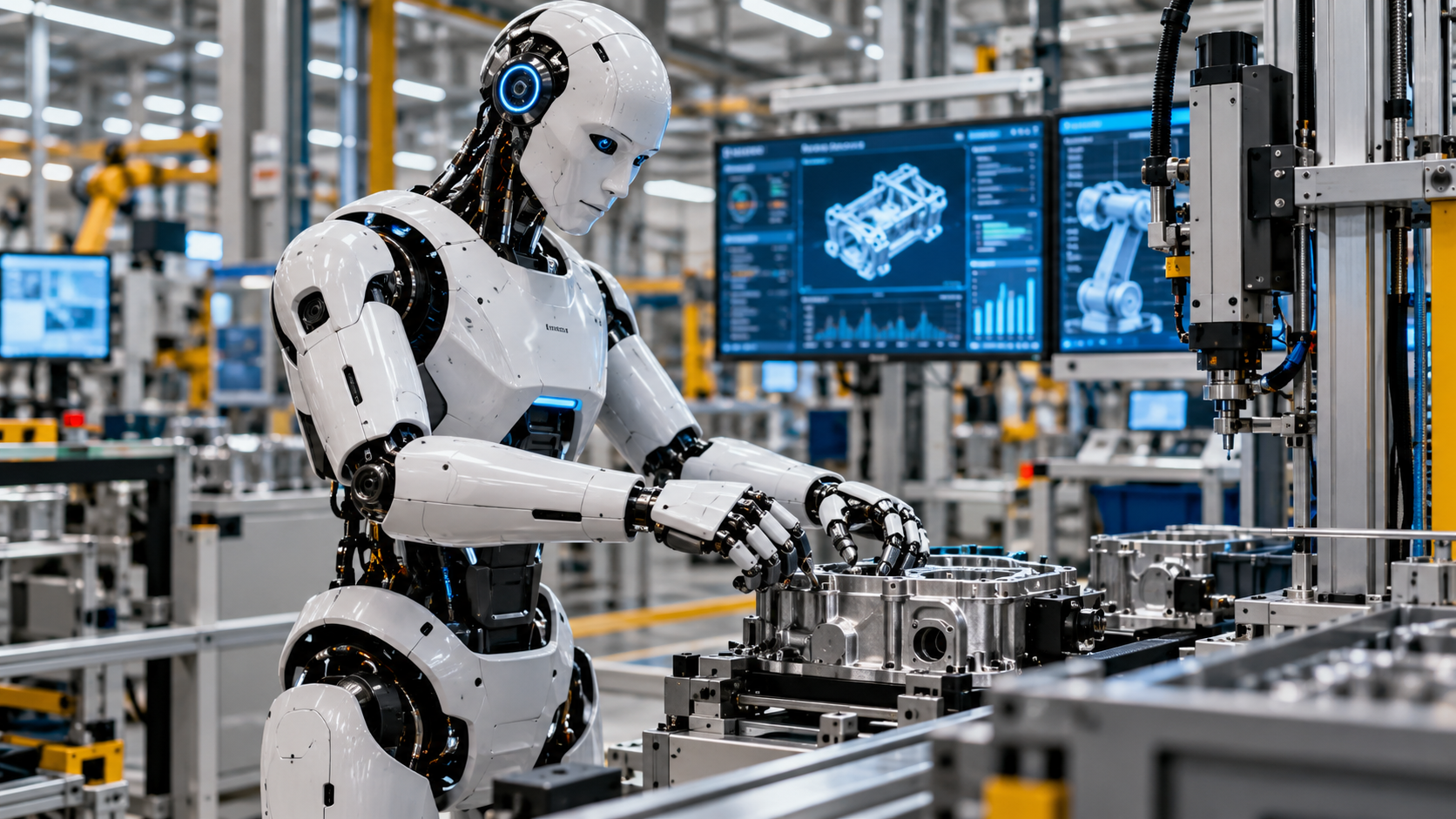
Manufacturing is one of the most important areas for humanoid robotics.
Factories already contain extensive automation, but there are still many physical activities that can be difficult to automate using fixed equipment.
A humanoid could potentially:
- Transport components
- Move parts between stations
- Load or unload materials
- Perform repetitive assembly activities
- Handle tools
- Support inspection processes
- Move objects around a production area
The potential advantage is flexibility.
Instead of installing a dedicated machine for one narrow task, a company could eventually use a more general-purpose robot that can be trained for multiple activities.
However, this doesn’t mean humanoids will replace every conventional industrial robot.
Traditional automation remains extremely effective for specialized tasks. A fixed robotic arm may be faster, cheaper, and more precise for a particular operation.
Humanoids are most interesting where flexibility has real economic value.
Humanoid Robots in Warehouses
Warehouses are another natural testing environment.
Workers may spend large portions of their shifts walking, lifting, carrying, sorting, and moving products.
These activities can be physically demanding and repetitive.
A humanoid robot could potentially perform some of these tasks while humans focus on work requiring judgment, problem-solving, supervision, or handling unusual situations.
However, warehouses aren’t perfectly controlled environments.
Boxes can be damaged. Products come in different shapes and sizes. People and vehicles move through the same areas. Inventory changes constantly.
A robot must therefore be capable of responding to situations that weren’t explicitly programmed in advance.
Humanoid Robots and Healthcare
Healthcare presents interesting opportunities but also much stricter safety requirements.
Humanoid robots could potentially assist with non-clinical activities such as:
- Transporting supplies
- Moving equipment
- Delivering items between departments
- Supporting hospital logistics
- Performing repetitive physical tasks
Direct interaction with patients is considerably more complicated.
A robot assisting a person with mobility, for example, must be able to respond safely if that person moves unexpectedly or loses balance.
This means healthcare robotics will require strong safety systems, dependable hardware, careful testing, and appropriate regulatory oversight.
Could Humanoid Robots Work in Homes?
The home is one of the most ambitious targets for humanoid robotics.
Imagine a robot that could clean a room, carry laundry, organize objects, unload a dishwasher, bring something from another room, or help an elderly person with routine tasks.
It sounds simple until you consider how unpredictable a normal home can be.
There may be:
- Pets
- Children
- Stairs
- Toys on the floor
- Fragile objects
- Different furniture
- Spilled liquids
- Narrow spaces
- Unfamiliar objects
- Constantly changing conditions
A factory can be optimized for a robot.
A home generally can’t.
That’s why household robotics may require significantly more advanced perception, reasoning, manipulation, and safety than many industrial applications.
The Importance of Robotic Hands
Walking attracts attention because it’s easy to see.
But robotic hands may be one of the most important parts of the technology.
Human hands are incredibly versatile. We can pick up a glass without crushing it, open a door, turn a key, use a screwdriver, fold clothes, and manipulate tiny objects.
A humanoid robot needs similar dexterity if it is going to perform a broad range of tasks.
Modern robotic hands are therefore being developed with increasingly sophisticated mechanisms and sensing capabilities.
The goal isn’t simply to create five robotic fingers. The system needs to understand how much force to apply and how an object is responding to that force.
That requires coordination between hardware, tactile sensing, computer vision, and AI.
Physical AI Is Changing Robotics
The rise of generative AI has also influenced robotics.
Large AI models can process language and other forms of information. Robotics researchers are exploring ways to connect those capabilities with physical machines.
This creates a different type of interaction.
Instead of programming:
Move arm 30 centimeters forward.
a person could potentially give a higher-level instruction:
Pick up the package and place it on the table.
The robot then needs to translate that instruction into a sequence of physical actions.
This requires several capabilities working together:
Language understanding → perception → planning → movement → feedback
If something goes wrong, the robot needs to recognize the problem and adjust.
That ability to recover from mistakes could be more important than simply performing a task correctly under perfect conditions.
The Biggest Challenges Facing Humanoid Robots
Humanoid robotics has made substantial progress, but serious technical problems remain.
Battery Life
Walking and moving multiple joints require substantial energy.
A robot that can only operate for a short period before charging may not be practical for many commercial applications.
Battery capacity, weight, charging time, and energy efficiency therefore remain important engineering considerations.
Balance
Humans constantly make small adjustments to remain upright.
Robots must do the same.
A humanoid needs to respond quickly when it encounters uneven ground, an unexpected object, or a change in weight distribution.
Maintaining balance while carrying something makes the problem even harder.
Dexterity
Picking up an object isn’t enough.
A robot must be able to manipulate objects without dropping, damaging, or incorrectly positioning them.
This becomes particularly difficult when the object is unfamiliar.
Safety
Humanoid robots may operate close to people.
That creates significant safety requirements.
Engineers need to account for:
- Unexpected collisions
- Falls
- Motor failures
- Sensor errors
- Software problems
- Human movement
- Emergency shutdowns
Safety cannot be treated as an optional feature. It has to be built into the complete robotic system.
Reliability
A demonstration that works once isn’t enough for a business.
Commercial customers need predictable performance over long operating periods.
If a robot frequently needs human assistance, maintenance, or resetting, its economic value can quickly decline.
This is why real-world testing is so important.
Humanoid Robots vs Traditional Robots
Humanoid robots aren’t necessarily a replacement for existing automation.
Consider a traditional robotic arm.
It can be extremely accurate, fast, and reliable when performing a specific operation.
Now consider a humanoid.
It may be able to walk between stations, carry objects, interact with tools, and perform several different tasks.
These are fundamentally different approaches.
| Humanoid Robots | Traditional Robots |
|---|---|
| More flexible movement | Often optimized for one task |
| Can potentially work in human spaces | Often require specialized setups |
| Designed for broader physical tasks | Excellent at repetitive operations |
| Can move between locations | Often fixed in one location |
| Potentially more adaptable | Usually highly predictable |
Neither approach automatically wins.
The right choice depends on the environment, task, cost, speed, and required flexibility.
Are Humanoid Robots Going to Replace Human Workers?
This question doesn’t have a single answer.
Some companies are developing humanoids specifically for physical tasks currently performed by people.
That could reduce demand for certain repetitive jobs in some industries.
At the same time, robotics can create demand for other roles, including:
- Robot technicians
- Robotics engineers
- AI specialists
- Safety specialists
- Robot trainers
- Automation managers
- Maintenance professionals
The effect will likely differ between industries.
A warehouse, automotive factory, hospital, and household may experience very different forms of automation.
The more useful question isn’t simply whether robots will replace humans.
It’s which tasks will become automated, which tasks will remain human-led, and what new work will emerge around the technology?
How Businesses Can Prepare for Humanoid Robots
Businesses don’t need to immediately purchase a humanoid robot to prepare for this technology.
A practical approach is to examine physical workflows first.
Identify Repetitive Work
Look for tasks involving:
- Repeated lifting
- Carrying
- Sorting
- Walking
- Material movement
- Simple manipulation
Measure the Current Process
Track how much time employees spend on the task and identify bottlenecks, safety concerns, and unnecessary movement.
Evaluate Automation Options
Don’t assume a humanoid is the only solution.
Compare it with robotic arms, conveyors, autonomous mobile robots, specialized equipment, and other automation technologies.
Start With a Pilot
If a humanoid appears suitable, test one clearly defined task.
Measure:
- Completion rate
- Human intervention
- Downtime
- Maintenance
- Safety
- Productivity
- Operating cost
Scale Only After Proving Value
A successful pilot can provide evidence for broader deployment.
This approach is more useful than adopting robotics simply because the technology is attracting attention.
Common Misconceptions About Humanoid Robots
Humanoid robots can already do everything humans do
They can’t.
Current systems remain limited in areas such as dexterity, autonomy, reliability, energy efficiency, and handling unpredictable situations.
Humanoid robots are only for entertainment
Not anymore.
Manufacturing, logistics, research, and other professional environments are increasingly becoming targets for humanoid robot development.
Every humanoid robot needs a human-like face
No.
The body shape is primarily about functionality. A robot can have a highly mechanical appearance and still be considered humanoid.
Humanoid robots will replace every other type of robot
That’s unlikely.
Specialized robots will continue to make sense for tasks where speed, precision, and repeatability matter more than flexibility.
What Does the Future Hold?
The future of humanoid robots will probably be determined less by impressive demonstrations and more by practical performance.
Can a robot work for hours without intervention?
Can it safely interact with people?
Can it pick up unfamiliar objects?
Can it recover from mistakes?
Can it perform useful work at a cost businesses can justify?
These are the questions that will shape the next stage of the industry.
The technology has several pieces moving forward at the same time: AI models, computer vision, sensors, actuators, batteries, simulation, and robotic control.
If these technologies continue improving together, humanoid robots could eventually become a flexible form of physical automation.
But widespread adoption won’t happen simply because robots become more intelligent.
They also need to become reliable, safe, affordable, maintainable, and genuinely useful.
That’s the real test.
Final Thoughts
Humanoid robots represent a major shift in how engineers think about automation.
Traditional robots are often designed around a specific task. Humanoid robots are being developed with a broader goal: creating machines capable of operating in environments already built for humans.
Manufacturing and logistics are likely to remain important areas for early adoption because they provide relatively structured environments where robots can demonstrate measurable value. read more