Space exploration is entering a new era. For decades, space missions depended on large rockets, expensive spacecraft, complex ground systems, and years of preparation. Although these technologies made remarkable achievements possible, the future of space exploration is expected to look very different.
New space technology is helping scientists and engineers develop spacecraft that are smaller, smarter, more efficient, and capable of performing tasks that once required much larger systems. Advances in artificial intelligence, reusable launch vehicles, advanced propulsion, robotics, satellite technology, communication systems, and materials are opening new possibilities for missions beyond Earth.
These developments could change how spacecraft are designed, how astronauts operate in space, and how missions explore the Moon, Mars, asteroids, and the outer regions of the solar system.
The New Era of Space Technology
Space technology has traditionally been expensive because spacecraft must survive extreme conditions. They need to operate in environments with radiation, extreme temperatures, limited communication, and no possibility of quick repairs.
Modern engineering is gradually changing this approach.
Instead of building every spacecraft as a massive and highly specialized machine, researchers are developing smaller systems that can work together. Advances in electronics, computing, sensors, batteries, communications, and manufacturing are making it possible to build capable spacecraft at lower sizes and potentially lower costs.
This could allow space agencies, private companies, universities, and research organizations to participate in missions that were previously available only to a small number of major institutions.
The result could be a more flexible and accessible space industry.
Artificial Intelligence Could Make Spacecraft Smarter
Artificial intelligence is one of the technologies with the potential to have a major impact on future space missions.
Communication between Earth and distant spacecraft can take time. When a spacecraft is exploring a distant planet or operating far from Earth, it cannot always wait for instructions from mission controllers.
AI could help spacecraft make certain decisions independently.
An intelligent spacecraft could analyze images, identify interesting geological features, detect unusual changes, manage resources, and prioritize scientific observations.
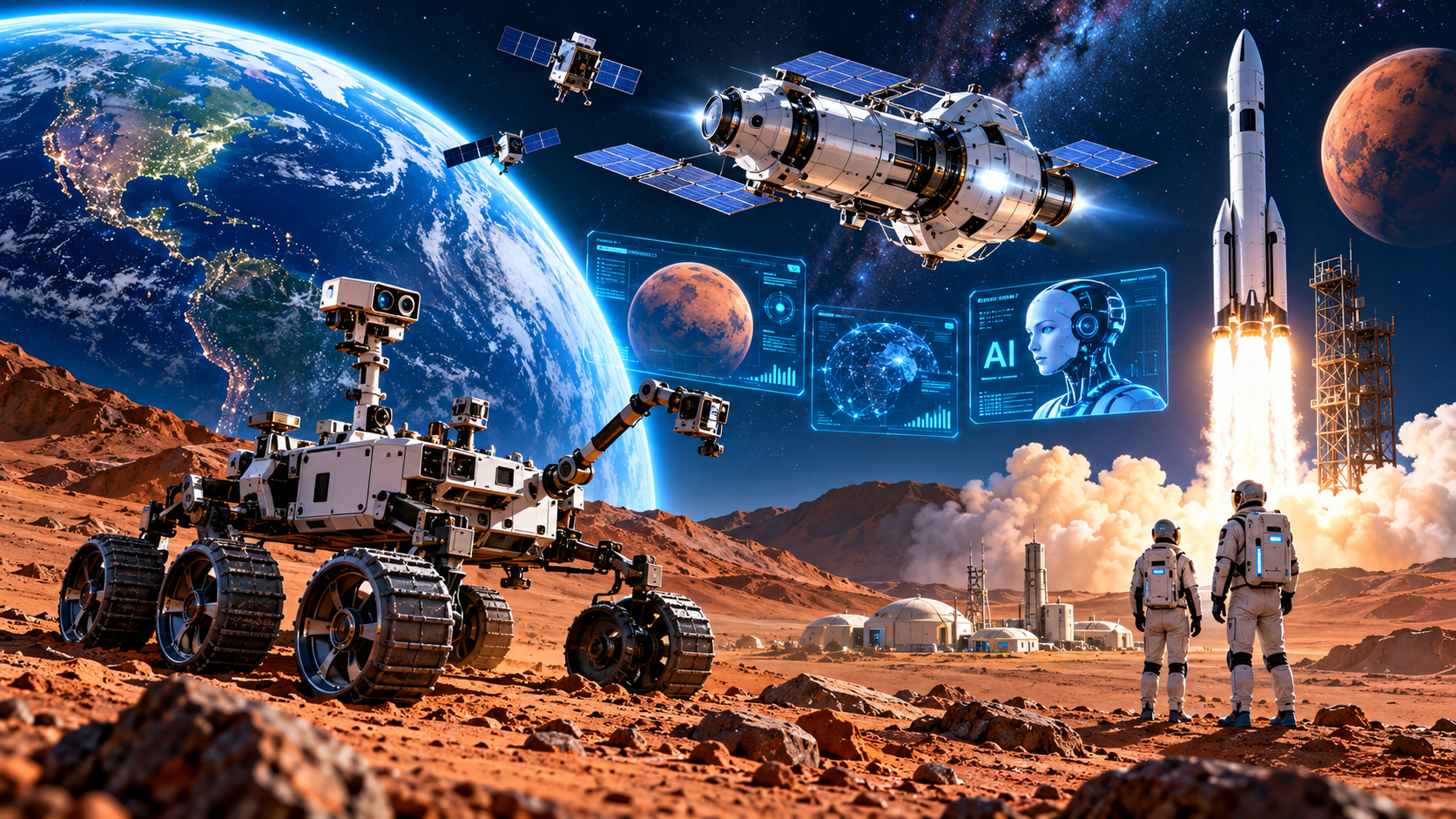
For example, a rover exploring Mars could identify a rock that appears scientifically interesting and decide to collect additional data before moving to another location.
This does not necessarily mean spacecraft will operate without human supervision. Instead, AI could act as an additional layer of decision-making that allows humans to focus on more important mission objectives.
Greater autonomy could become especially valuable as missions travel farther from Earth.
Small Satellites Could Transform Space Missions
Small satellites have become an important part of modern space technology.
Traditional satellites can be large, expensive, and complicated to build. Small satellites can be developed with fewer resources and may be launched as part of larger missions.
Some small spacecraft, including CubeSats and other small satellite designs, can perform scientific experiments, observe Earth, test technologies, and demonstrate new communication systems.
One of the biggest advantages of small spacecraft is flexibility.
Instead of depending on a single large spacecraft, future missions could potentially use groups of smaller spacecraft working together.
If several spacecraft cooperate, they could observe different locations simultaneously or create a distributed network of sensors.
This concept could become useful for missions around the Moon, asteroids, Mars, and other destinations.
Reusable Rockets Could Reduce Launch Costs
Getting equipment into space has historically been one of the most expensive parts of a mission.
Reusable rocket technology is changing this situation.
Instead of using a launch vehicle once and allowing most of it to be discarded, reusable systems are designed to return significant portions of the vehicle for future flights.
More frequent reuse could help reduce the cost and increase the frequency of launches.
Lower launch costs could have a wider effect on space exploration. Researchers could send more scientific instruments into orbit, companies could deploy additional satellites, and space agencies could consider missions that might previously have been too expensive.
Reusable launch technology could therefore become an important foundation for a more active space economy.
Advanced Propulsion Could Enable Longer Missions
Rocket propulsion is another area receiving significant attention.
Chemical rockets are extremely powerful, but they consume large amounts of propellant. For missions that travel enormous distances, engineers are exploring propulsion systems that can operate more efficiently over long periods.
Electric propulsion is one example.
Rather than producing enormous thrust for a short period, some electric propulsion systems can provide lower thrust continuously for long periods. Over time, this can allow spacecraft to reach high velocities while using relatively little propellant.
Other advanced propulsion concepts are also being studied, including nuclear-based systems and other technologies that could potentially reduce travel times or improve mission efficiency.
If these technologies become practical for future missions, they could influence how spacecraft travel throughout the solar system.
Robots Could Prepare the Way for Humans
Robotics will likely play a major role in future space exploration.
Robots can perform dangerous tasks without putting human lives at risk. They can operate in environments that would be extremely difficult for astronauts and can work for long periods without food, oxygen, or other human life-support requirements.
Future robotic systems could help prepare landing sites, inspect equipment, collect samples, build infrastructure, and search for useful resources.
On the Moon, for example, robotic systems could potentially help map terrain, investigate water ice, move equipment, and prepare areas for future human operations.
Robotic technology could therefore serve as a bridge between unmanned exploration and long-term human missions.
Lunar Technology Could Support Future Exploration
The Moon is becoming an important destination for future space exploration.
Unlike Mars, the Moon is relatively close to Earth, making it a useful environment for testing technologies that could eventually be used farther away.
Future lunar missions may require advanced landing systems, autonomous robots, communication networks, power systems, navigation technologies, and resource-processing equipment.
One area of interest is the use of local resources.
If future missions can effectively use materials found on the Moon, spacecraft may not need to carry every resource from Earth.
Water ice, for example, could potentially become an important resource if it can be extracted and processed efficiently.
Such capabilities could help support longer-duration missions and potentially contribute to future lunar infrastructure.
New Materials Could Make Spacecraft More Durable
Spacecraft need to withstand harsh conditions.
Advanced materials could help engineers build lighter and stronger vehicles.
New composites, protective coatings, thermal materials, and manufacturing techniques may improve spacecraft performance while reducing mass.
Reducing mass is particularly important because every additional kilogram launched into space can affect mission costs and fuel requirements.
Advanced materials could also help protect spacecraft from radiation, extreme temperatures, micrometeoroids, and other environmental hazards.
As materials science continues to develop, future spacecraft may become more resilient without becoming significantly heavier.
3D Printing Could Help Build Equipment in Space
Manufacturing in space could eventually become an important capability.
Today, most equipment used in space must be manufactured on Earth and transported through a launch vehicle.
That creates limitations.
If astronauts need a specialized tool that was not included in the original mission, they may have to wait for a resupply mission or find another solution.
3D printing could help address this problem.
A future space station or lunar facility could potentially manufacture certain tools, components, replacement parts, or structural elements when required.
In the longer term, researchers are also studying whether local materials could be used for manufacturing on the Moon or Mars.
This could reduce dependence on supplies transported from Earth.
Better Space Communication
Communication is essential for every space mission.
Spacecraft need to transmit scientific data, images, measurements, and operational information back to Earth.
As missions move farther away, communication becomes more difficult.
Future communication technologies could improve data transmission between spacecraft, satellites, and ground stations.
Laser communication is one technology being developed to provide high-speed data connections over long distances.
Compared with traditional radio communication, optical systems can potentially transmit large amounts of data at high rates.
This could become increasingly important as spacecraft produce higher-resolution images, scientific measurements, and other large datasets.
Autonomous Navigation Could Change Deep-Space Missions
Navigation becomes more challenging as spacecraft travel farther from Earth.
Traditional missions rely heavily on ground-based tracking and navigation.
Future spacecraft could use more advanced autonomous navigation systems.
Artificial intelligence, cameras, sensors, star trackers, and other instruments could allow spacecraft to determine their position and adjust their trajectory with greater independence.
Autonomous navigation could be especially valuable for missions involving multiple spacecraft or destinations where communication delays make constant human control difficult.
It could also help spacecraft respond quickly to unexpected conditions.
Space Telescopes Are Becoming More Powerful
New space technology is also changing astronomy.
Space telescopes allow scientists to observe the universe without many of the limitations caused by Earth’s atmosphere.
Modern observatories can study distant galaxies, stars, planets, and other astronomical objects using different wavelengths of light.
Future telescopes may become even more powerful through improved mirrors, sensors, cooling systems, communications, and spacecraft designs.
Artificial intelligence can also help scientists analyze the enormous quantities of data generated by modern observatories.
Instead of manually examining every observation, researchers can use advanced software to identify patterns, unusual objects, and potential discoveries.
AI Could Help Protect Astronauts
Human spaceflight presents many risks.
Astronauts may be exposed to radiation, isolation, microgravity, limited resources, and other hazards.
AI systems could help monitor spacecraft environments and astronaut conditions.
Intelligent systems could detect unusual equipment behavior, identify potential problems, and help crews respond to emergencies.
Automation could also reduce the number of routine tasks astronauts have to perform.
This could give astronauts more time to focus on scientific experiments, exploration, and mission-critical activities.
Mars Missions Will Need New Technology
Mars remains one of the most challenging destinations for human exploration.
The distance between Earth and Mars creates major communication delays. Missions also need to deal with extreme environmental conditions, limited resources, and long travel times.
Future Mars missions will require highly reliable life-support systems, autonomous robotics, advanced power generation, efficient propulsion, radiation protection, and sophisticated communication networks.
Technology developed for lunar missions may provide useful experience, but Mars will require additional solutions.
AI and autonomous robotics could be particularly important because astronauts and ground controllers cannot operate every system manually at all times.
Space Technology Could Support Long-Term Human Presence
The long-term goal of many space exploration programs is not simply to visit another world.
It is to develop the ability to operate there for extended periods.
This requires infrastructure.
Future missions may need reliable power systems, habitats, communication networks, transportation, resource processing, scientific facilities, and maintenance systems.
New technology could make these systems smaller, more efficient, and more autonomous.
The ability to repair and manufacture equipment locally could be particularly important.
A sustainable space presence will require much more than powerful rockets. It will require an entire technological ecosystem.
Challenges Still Need to Be Solved
Despite rapid progress, new space technology comes with significant challenges.
Space systems must be extremely reliable because repairs are often difficult or impossible.
A technology that works perfectly on Earth may behave differently in space.
Radiation can damage electronics. Extreme temperatures can affect materials. Dust can create problems for mechanical systems. Communication delays can complicate operations.
There are also financial and regulatory challenges.
Developing advanced spacecraft requires significant investment, testing, and engineering expertise.
Safety is another major concern, particularly when missions involve human astronauts.
New technology must therefore be tested carefully before it becomes part of critical missions.
The Future of Space Exploration
The next generation of space missions may look very different from the missions of the past.
Spacecraft could become more autonomous. Rockets could become more reusable. Satellites could become smaller and more numerous. Robots could perform increasingly complex tasks. AI could help spacecraft analyze their surroundings and make decisions.
At the same time, advanced propulsion and communication technologies could expand the range of missions that are practical.
These technologies are not developing independently.
Their greatest impact may come from combining them.
A small autonomous spacecraft equipped with advanced sensors, AI, efficient propulsion, and high-speed communication could perform tasks that once required a much larger mission.
This combination of technologies could make space exploration more flexible and capable.
Conclusion
New space technology could fundamentally change how humanity explores the universe.
Artificial intelligence can provide greater autonomy, robotics can perform dangerous tasks, reusable rockets can support more frequent launches, advanced propulsion can improve spacecraft efficiency, and small satellites can enable flexible mission designs.
At the same time, advanced materials, 3D printing, autonomous navigation, laser communication, and improved life-support systems could help make longer and more ambitious missions possible.