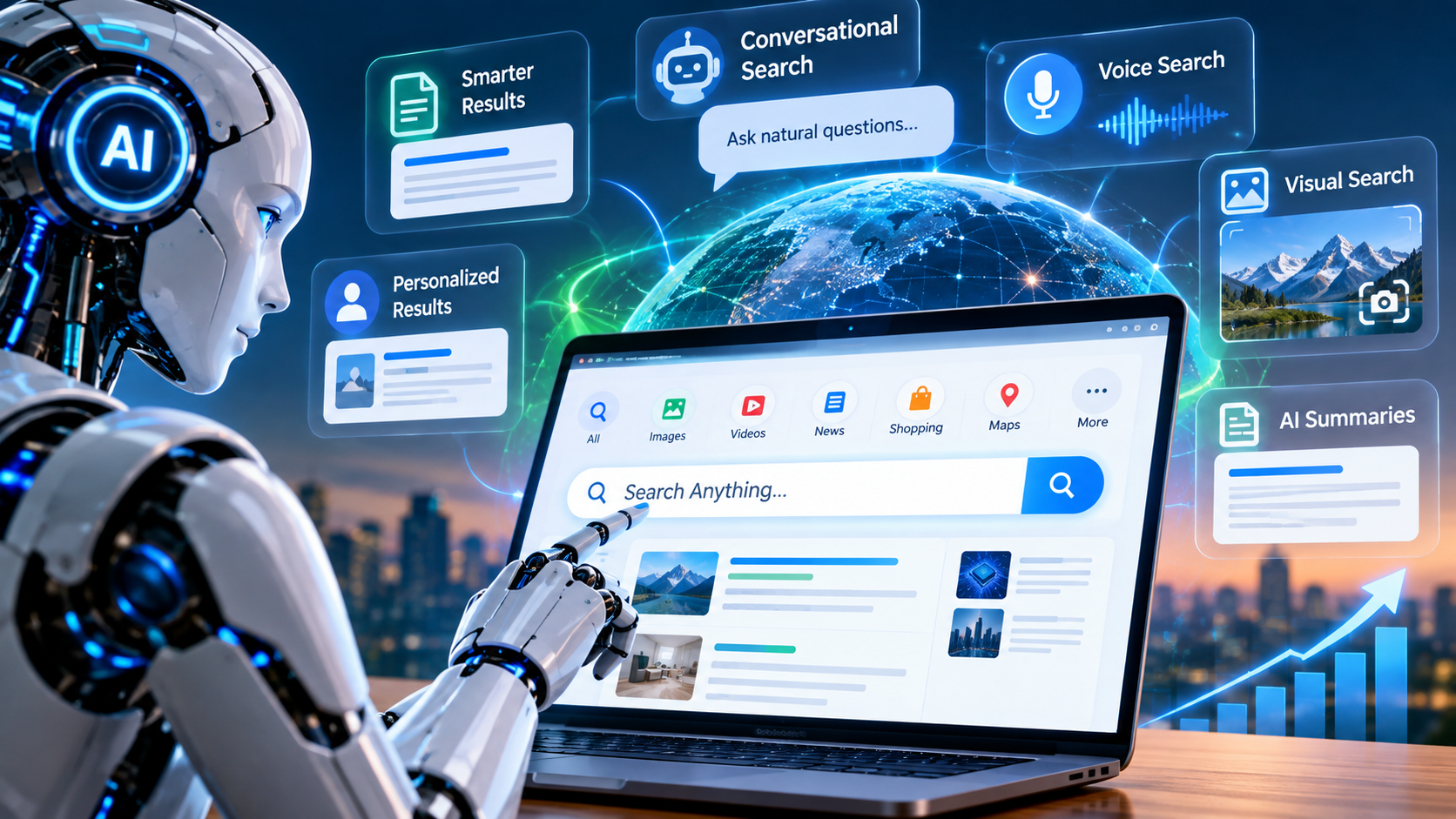
For decades, using a computer has meant telling software exactly what to do. We open an application, click buttons, type commands, search for information, and move between different websites to complete a task. Even simple jobs can require many small steps.
AI agents are beginning to change that experience.
Instead of simply responding to questions or generating text, AI agents can understand a goal and take multiple actions to achieve it. They can work with applications, search for information, organize files, analyze data, write content, complete repetitive tasks, and in some cases interact with websites and other digital tools.
This is creating a new way of thinking about computers. Rather than people constantly controlling software step by step, people can increasingly describe what they want and let an AI system handle much of the process.
The technology is still developing, but its potential is already attracting attention across business, education, software development, customer service, and everyday computing.
What Are AI Agents?
An AI agent is a software system designed to work toward a goal rather than simply provide a single response.
A traditional chatbot might answer a question such as, “What are the best ways to organize my files?”
An AI agent could potentially take the next steps. It might inspect the files, identify different categories, create folders, rename documents according to a chosen system, and prepare a summary of what it changed.
The important difference is action.
AI agents can combine reasoning with tools. Depending on the system, those tools may include web browsers, databases, software applications, APIs, spreadsheets, email platforms, cloud storage, and other computer systems.
This means an agent can move from:
“Tell me how to do it”
to:
“Do it for me.”
That shift could have a major effect on how people interact with computers.
From Clicking Buttons to Giving Instructions
The graphical user interface changed computing by making computers easier to operate. Instead of memorizing complicated commands, people could click icons, open menus, drag files, and interact with visual elements.
AI agents may represent another major change.
Users may not always need to know which application to open or which button to press. They can explain the desired outcome in ordinary language.
For example, instead of opening a spreadsheet, searching through data, creating formulas, building a chart, and writing a report, a user could potentially tell an AI agent:
“Analyze this month’s sales data, find the biggest changes, create a chart, and prepare a short report.”
The agent could then determine which steps are necessary.
This does not mean traditional interfaces will disappear. People will still use applications directly. But AI agents could become another layer between users and software.
AI Agents Can Handle Multi-Step Tasks
One of the most interesting characteristics of AI agents is their ability to work through multiple steps.
Consider a simple business task.
A person might receive an email asking for information about a product. They may need to:
- Read the email
- Identify the customer’s question
- Search company documentation
- Find the relevant product information
- Check current pricing
- Write a response
- Attach a document
- Send the email
Today, a person may handle every part manually.
An AI agent could potentially perform several of these steps after receiving a clear instruction and having the necessary permissions.
The agent could understand the request, gather information from approved sources, prepare a response, and ask the user for confirmation before sending it.
That last step is important. Giving an AI the ability to perform actions also means users need ways to control what it can and cannot do.
Computers Could Become More Goal-Oriented
Most software is designed around specific functions.
A calendar application manages appointments. A spreadsheet manages data. A browser accesses websites. An email application manages messages.
AI agents can potentially connect these separate tools around a user’s goal.
Imagine telling an agent:
“Help me prepare for tomorrow’s meeting.”
Depending on its permissions and connected tools, the agent might review the calendar, identify the meeting, collect relevant documents, summarize previous notes, prepare talking points, and organize everything in one place.
The user does not necessarily need to think about which application performs each task.
This could make computers feel less like collections of separate programs and more like a connected working environment.
AI Agents Could Change Office Work
Businesses are among the areas where AI agents could have a significant impact.
Many office jobs involve repetitive digital tasks. Employees regularly move information between systems, summarize documents, prepare reports, organize spreadsheets, respond to routine messages, and check databases.
These tasks can consume a large amount of time even when they are not particularly difficult.
AI agents could help automate parts of this work.
For example, a marketing team might use an agent to collect campaign data from different platforms, identify changes, prepare a weekly summary, and highlight areas that deserve attention.
A finance team could use an agent to organize financial information and identify unusual changes for human review.
A customer support team could use agents to handle routine requests while sending complicated cases to human employees.
The goal is not necessarily to remove humans from the process. In many cases, the more practical goal is to reduce repetitive work so people can spend more time on tasks requiring judgment, communication, creativity, and decision-making.
Software Development Is Also Changing
AI agents are becoming particularly interesting in software development.
Programming normally requires developers to understand a problem, design a solution, write code, test it, identify errors, and make improvements.
AI coding systems can already assist with several of these tasks. More advanced agent-style systems can work through larger portions of the development process.
A developer might describe a feature and ask an AI system to inspect an existing codebase, determine where changes are needed, write the code, run tests, identify problems, and suggest fixes.
This changes the developer’s role.
Instead of manually writing every line of code, developers can increasingly spend more time describing requirements, reviewing generated code, testing results, and making architectural decisions.
However, AI-generated code still requires careful review. An agent can misunderstand requirements, introduce bugs, use an unsuitable approach, or create security problems.
Human oversight remains important.
AI Agents Are Not Perfect
The excitement around AI agents should not hide their limitations.
AI systems can make mistakes. They may misunderstand instructions, rely on incorrect information, or perform an action differently from what the user intended.
The problem becomes more serious when an AI agent has access to important systems.
For example, an agent that can draft an email is relatively low-risk. An agent that can send emails without confirmation has more responsibility. An agent with access to financial accounts or sensitive business systems requires even stronger controls.
This is why permissions, monitoring, authentication, and human approval are becoming important parts of agent design.
A useful AI agent should not simply be capable of taking action. It should also know when it needs permission to continue.
Privacy Is Another Major Concern
AI agents may need access to personal and business information to be useful.
An agent might need access to documents, calendars, emails, websites, databases, or internal company systems.
That creates obvious privacy questions.
Who can see the information?
Where is the information processed?
How long is it stored?
What happens if the agent makes a mistake?
What happens if an attacker gains access to the system?
These questions will become increasingly important as AI agents become more integrated into everyday computing.
Users should understand what permissions an agent has and what actions it is allowed to perform.
Companies will also need strong security policies before allowing agents to work with sensitive information.
AI Agents Could Make Technology More Accessible
One of the biggest benefits of agent-based computing could be accessibility.
Many computer programs have complicated interfaces. A user may need to learn where features are located and understand technical terminology before completing a task.
Natural-language interaction can reduce some of that complexity.
A person could describe what they want in everyday language rather than learning a complicated application.
This could be particularly useful for people who are less comfortable with technology.
Instead of asking someone:
“Which menu contains the export function?”
they could simply say:
“Save this information as a spreadsheet.”
The AI agent could handle the technical details in the background.
The Web Could Become More Agent-Friendly
AI agents may also change how people use the internet.
Today, people usually visit websites themselves. We search Google, open pages, compare information, fill out forms, and complete purchases or bookings.
In an agent-driven environment, some of these activities could happen through software acting on behalf of the user.
For example, a person might say:
“Find three suitable hotels for my trip based on these requirements.”
The agent could search available options, compare prices and features, and present the results.
The user would still make the final decision, but much of the research process could be automated.
This could also force websites and online services to rethink how their systems interact with software agents.
AI Agents and the Future of Search
Traditional search engines are built around users entering queries and receiving links.
AI assistants have already started changing this model by providing direct answers.
AI agents could take the next step.
Instead of simply answering:
“How do I create a backup?”
an agent could potentially inspect the user’s setup and guide or perform the necessary steps, depending on permissions.
Search could therefore become less about finding information and more about completing tasks.
This does not mean traditional search will disappear. Search remains useful for exploring information, comparing sources, and discovering new content.
But the way people access that information may continue to evolve.
What Will Happen to Traditional Software?
AI agents are unlikely to make traditional software irrelevant overnight.
Applications will continue to provide specialized tools and interfaces. Professional users often need precise control over their work.
However, the relationship between users and applications could change.
Instead of opening five different programs and moving information between them manually, users may increasingly rely on an AI layer that coordinates those applications.
The software still exists. The agent simply helps connect it.
This could make the computer feel more personalized because the interface is based less on the application’s structure and more on the user’s goals.
Humans Will Still Be Important
Despite the growing capabilities of AI agents, humans remain central to the process.
AI can process information quickly, automate repetitive actions, and work across multiple digital tools. But people still need to define goals, set boundaries, evaluate important decisions, and take responsibility for outcomes.
This is especially important in areas such as healthcare, finance, law, education, and business.
An AI agent can help organize information, but that does not automatically make its conclusions correct.
The best results are likely to come from collaboration between humans and AI rather than treating the agent as an unquestionable authority.
A New Way to Think About Computers
The biggest change brought by AI agents may not be a particular feature or application. It may be a change in the basic relationship between humans and computers.
For years, people have adapted themselves to software.
We learned how applications work, where buttons are located, which menus contain certain functions, and which steps are necessary to complete a task.
AI agents could allow software to adapt more closely to the way people naturally express their goals.
Instead of thinking:
“Which program should I open?”
users may increasingly think:
“What do I want to accomplish?”
That is a meaningful change.
Conclusion
AI agents are moving computers toward a more goal-oriented and conversational future. They can combine AI reasoning with access to digital tools, allowing them to handle tasks that previously required people to move between multiple applications and complete each step manually.
The technology still has important limitations. Accuracy, privacy, security, permissions, and human oversight will all matter as agents become more capable.
But the direction is clear: computers are becoming more capable of understanding what people want rather than simply waiting for people to tell them exactly where to click.