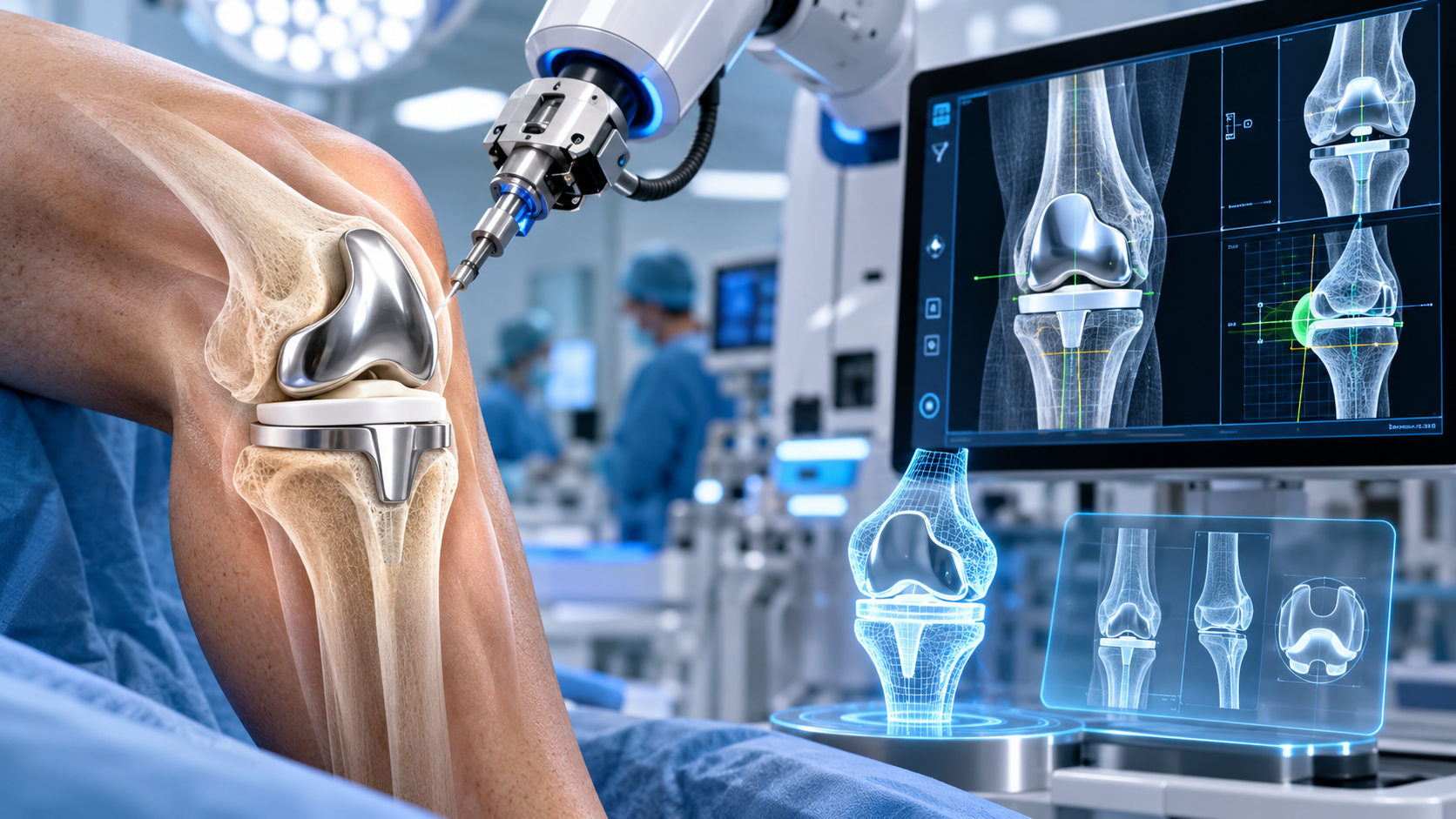
Knee replacement surgery has changed considerably in recent years. While traditional knee replacement is still widely used for people with severe joint damage, surgeons now have access to a growing range of tools that can assist with planning, implant positioning, alignment, and patient recovery.
When people search for the latest knee replacement technology, they may expect to find one new device or a single breakthrough treatment. In reality, modern knee replacement involves several different technologies and surgical approaches. Robotic-assisted surgery, computer navigation, 3D imaging and planning, newer implant designs, digital recovery tools, and evolving alignment techniques are some of the developments being used today.
These technologies do not all serve the same purpose. Some are used during surgery to help the surgeon plan and position the implant, while others are designed to support rehabilitation and monitor a patient’s recovery after the procedure.
It is also important to remember that newer technology is not automatically better for every patient. The most appropriate approach can depend on the amount of joint damage, knee anatomy, overall health, activity level, and the surgeon’s experience with a particular technique.
In this guide, we will look at the major developments in modern knee replacement, how these technologies work, what potential benefits and limitations they have, and what patients may want to discuss with their orthopedic surgeon before choosing a treatment.
What Is Knee Replacement Surgery?
Knee replacement surgery—medically known as knee arthroplasty—is a procedure where worn-out or damaged parts of the knee joint are swapped out for artificial implants.
At its core, your knee is made up of three main bones: the lower thigh bone (femur), the upper shin bone (tibia), and your kneecap. Normally, a smooth layer of cartilage cushions these bones so they glide effortlessly against each other. But conditions like osteoarthritis can slowly wear down that cartilage, leading to daily pain, stiffness, swelling, and making simple things like walking or climbing stairs a real challenge.
If you go through a total knee replacement, a surgeon clears away the damaged bone and cartilage, fitting the joint with new, artificial parts. Typically, metal caps go onto the ends of the femur and tibia, with a durable plastic spacer sandwiched between them to mimic that natural gliding motion. Depending on how worn it is, the underside of the kneecap might get resurfaced, too.
According to experts at Johns Hopkins Medicine, this kind of surgery is usually recommended when severe joint damage is interfering with your daily life and other treatments—like physical therapy or medication—just aren’t cutting it anymore.
These days, advanced technology plays a big part from start to finish. Surgeons use it to meticulously plan the procedure beforehand, guide accuracy in the operating room, and even track your progress during post-op rehabilitation.
Why Is Knee Replacement Technology Changing?
Every patient’s knee is different.People have different bone shapes, ligament structures, alignment, activity levels, and patterns of joint damage. Older surgical approaches often relied heavily on standardized instruments and conventional measurements.
Newer technologies allow surgeons to collect more information about an individual knee before and during surgery.
For example, computer-assisted systems can provide information about alignment and implant positioning. Robotic systems can help surgeons execute a preoperative plan. Digital platforms can guide patients through exercises and recovery milestones.
The goal is not simply to make surgery more complicated. The goal is to give the surgical team better information and more options for tailoring treatment to the individual patient.
Robotic-Assisted Knee Replacement
Robotic-assisted surgery is one of the most discussed developments in modern knee replacement.A robotic system does not independently replace the surgeon. Instead, it generally works as a planning and guidance tool. The surgeon remains responsible for decisions and performs the operation while the technology provides information and controlled assistance.
Depending on the system, imaging or other data may be used to create a digital representation of the patient’s knee. The surgeon can then plan bone cuts and implant positioning based on the patient’s anatomy.
During surgery, the system can provide real-time information that helps the surgeon follow the planned approach.
The use of robotic assistance has increased substantially in the United States. Data from the American Joint Replacement Registry’s 2025 Annual Report show that robotic assistance was used in approximately 16.1% of primary total knee arthroplasty procedures in its 2024 aggregate analysis, compared with 1.8% in 2017.
However, patients should understand an important distinction: greater technological precision does not automatically mean better long-term outcomes for every patient.
An AAOS clinical practice guideline found that available evidence did not show a significant short-term difference in function, outcomes, or complications between robotic-assisted and conventional total knee replacement, although some studies have demonstrated greater accuracy or fewer alignment outliers with robotic systems.
3D Planning and Digital Knee Models
Three-dimensional planning is another important development in knee replacement.
Traditional planning can rely heavily on standard X-rays and measurements. Advanced systems can use imaging and software to create a digital model of the patient’s anatomy.
The surgeon can use this information to plan the size and position of components before entering the operating room.
A 3D model can help visualize:
- Bone shape
- Joint alignment
- Implant positioning
- Bone cuts
- Component sizing
- Areas of bone damage
- The relationship between different parts of the knee
Some robotic systems incorporate this type of planning directly into the surgical workflow.
The benefit is that the surgeon has more information available before the procedure begins. Instead of approaching every knee using exactly the same plan, the surgical strategy can be adapted to the patient’s anatomy.
Personalized Knee Replacement
Personalization is becoming a major theme in modern knee replacement. A conventional knee replacement does not necessarily mean that every implant is identical. Surgeons already select different implant sizes and configurations based on the patient’s anatomy.
New technologies can take personalization further by using more detailed measurements and individualized surgical plans.
The concept is relatively simple: rather than treating every knee as though it has the same shape and movement pattern, the surgical team can consider the patient’s individual anatomy.
Personalized planning may involve:
- Patient-specific measurements
- Computer-assisted planning
- 3D anatomical models
- Robotic guidance
- Individual implant sizing
- Alignment strategies
- Soft-tissue balancing
Kinematic Alignment: A More Personalized Approach
Kinematic alignment is another technique receiving attention in modern knee replacement.
Traditional alignment strategies often aim to position the replacement according to standardized mechanical alignment principles. Kinematic alignment takes a different approach by attempting to reproduce aspects of the patient’s natural knee anatomy and movement.
Johns Hopkins describes kinematic alignment as an approach that personalizes the procedure based on the patient’s anatomy and seeks to restore the knee’s pre-arthritis alignment rather than applying the same alignment strategy to every patient.
One of the concepts behind this technique is preserving the natural relationship between the bones and ligaments as much as possible.
However, kinematic alignment is not automatically appropriate for everyone. A surgeon must determine whether the technique fits the patient’s anatomy, joint damage, ligament condition, and overall surgical requirements.
This is an important example of why the term “latest” should not be confused with “best for every patient.”
Smart Knee Implants
Kinematic alignment is another technique receiving attention in modern knee replacement.
Traditional alignment strategies often aim to position the replacement according to standardized mechanical alignment principles. Kinematic alignment takes a different approach by attempting to reproduce aspects of the patient’s natural knee anatomy and movement.
Johns Hopkins describes kinematic alignment as an approach that personalizes the procedure based on the patient’s anatomy and seeks to restore the knee’s pre-arthritis alignment rather than applying the same alignment strategy to every patient.
One of the concepts behind this technique is preserving the natural relationship between the bones and ligaments as much as possible.
However, kinematic alignment is not automatically appropriate for everyone. A surgeon must determine whether the technique fits the patient’s anatomy, joint damage, ligament condition, and overall surgical requirements.
This is an important example of why the term “latest” should not be confused with “best for every patient.”
Smart Knee Implants
One of the more futuristic developments in knee replacement is the smart implant.
Some newer implants incorporate sensors designed to collect information about a patient’s activity and movement after surgery.
For example, the Persona IQ system described by orthopedic surgeon Nathan Cafferky uses sensors within the implant system to collect information such as range of motion, stride length, walking speed, and step count. The information can be supplied to the healthcare team to help monitor recovery.
This creates an interesting shift in postoperative care.
Traditionally, doctors may evaluate recovery during scheduled appointments and based on the patient’s description of pain, mobility, and daily activity. Sensor technology can potentially provide additional objective information between visits.
Smart implants are still a specialized technology rather than something every knee replacement patient needs.
Patients should ask their surgeon what information is collected, how it is used, how it is protected, and whether the technology is appropriate for their particular situation.
Digital Recovery and Remote Monitoring
Technology is also changing what happens after knee replacement.
Recovery does not end when the operation is finished. Physical therapy, exercise, mobility, pain management, and follow-up appointments all play important roles.
Digital recovery platforms can provide patients with instructions, reminders, exercise videos, progress tracking, and communication tools.
For example, the mymobility platform described by Dr. Cafferky’s practice provides patients with reminders, progress information, and exercise guidance through connected devices.
Digital rehabilitation can make it easier for patients to understand what they should do at different stages of recovery.
However, these tools are intended to support medical care, not replace professional evaluation. A patient’s recovery program should still be developed according to their individual circumstances.
Minimally Invasive Knee Replacement
Minimally invasive knee replacement focuses on reducing the size of the surgical incision and limiting disruption to surrounding tissues.
Johns Hopkins explains that minimally invasive total knee replacement uses a smaller incision than traditional surgery and may use specialized instruments to allow the surgical team to work through the smaller opening.Potential advantages can include less disruption to tissues and, in some cases, a faster early recovery.But minimally invasive surgery is not automatically appropriate for every patient.
The patient’s anatomy, weight, previous operations, joint deformity, severity of arthritis, and surgeon’s experience can all influence whether a minimally invasive approach is suitable.
Johns Hopkins also notes that while minimally invasive surgery may offer benefits such as reduced pain or recovery time, it is not yet clear that it reduces every type of complication compared with traditional approaches.
Techniques That Protect Your Muscles and Tendons
Modern knee replacement programs may also use approaches designed to limit disruption of muscles and tendons around the knee.The exact surgical approach depends on the patient’s anatomy and the surgeon’s preferred technique.The idea behind these approaches is to reach the joint while minimizing unnecessary disruption to surrounding structures.
Johns Hopkins currently describes its knee replacement program as including minimally invasive approaches, muscle- and tendon-sparing techniques, and robotic-assisted surgery.
Patients should remember that “minimally invasive” does not mean risk-free or scar-free. Knee replacement is still major surgery, and the surgical approach should be selected based on medical factors rather than marketing terminology.
How Computer Navigation Works Without a Robot
Robotic surgery gets much of the attention, but computer navigation is another important technology.Navigation systems can help surgeons understand the position and alignment of the bones during surgery.Unlike some robotic systems, computer navigation may not physically control or guide the surgical instrument. Instead, it provides information that helps the surgeon make decisions.
This distinction is useful because patients may hear terms such as:
- Robotic-assisted surgery
- Computer-assisted surgery
- Computer navigation
- Image-guided surgery
These technologies overlap in some areas but are not necessarily the same.The surgeon and hospital can explain which system they use and what role it plays during the operation.
Where Robotic Knee Surgery Is Heading Next
Robotic technology continues to develop.Recent orthopedic discussion has focused on making robotic systems more flexible and potentially less dependent on a single implant manufacturer.
The American Academy of Orthopaedic Surgeons reported in 2026 that robotic-assisted arthroplasty has become increasingly common and described ongoing development toward implant-agnostic or more interoperable robotic platforms.
The idea behind implant-agnostic systems is that a robotic platform could potentially work with a wider range of implant designs instead of being closely tied to one implant ecosystem.This is an evolving area, and patients should not assume that newer robotic architecture automatically translates into better clinical outcomes.
Partial Knee Replacement Technology
Not everyone with knee arthritis needs a total knee replacement.Some people have damage primarily confined to one compartment of the knee. In selected patients, a partial or unicompartmental knee replacement may be considered.A partial replacement preserves more of the patient’s natural knee than a total replacement.Modern imaging, patient selection, navigation, and robotic assistance can be used in some partial knee replacement procedures.
The American Joint Replacement Registry’s 2025 Annual Report Supplement analyzed more than 101,000 unicompartmental knee arthroplasty procedures performed between 2012 and 2024 and included analysis of surgical technique, including conventional jig-based and robotic-assisted procedures.
Whether partial replacement is appropriate depends on the location and extent of arthritis, ligament condition, alignment, age, activity level, and other factors.
Smarter, Stronger Knee Implants
The artificial components themselves continue to evolve.Knee replacement implants commonly use combinations of metal and highly durable plastic components. Researchers and manufacturers continue to investigate implant geometry, materials, bearing surfaces, fixation methods, and designs intended to improve durability and function.The objective is to create implants that can withstand years of repeated movement while maintaining appropriate stability.However, implant technology should not be considered separately from surgical technique.
A high-quality implant still needs appropriate sizing, positioning, fixation, and postoperative care.
Cemented and Cementless Knee Replacement
Another area of development is implant fixation.Traditional knee replacements often use bone cement to secure components. Cementless designs instead rely on the patient’s bone growing onto or into specially designed implant surfaces over time.The choice between cemented and cementless fixation depends on multiple factors, including bone quality, age, anatomy, surgeon preference, and implant design.There is no single fixation method that is automatically right for every patient.
This is another reason patients should discuss the complete treatment plan rather than focusing on one “new” technology.
What About Artificial Intelligence?
Artificial intelligence is increasingly being explored across healthcare, including orthopedic surgery.AI may eventually assist with areas such as:
- Medical image analysis
- Surgical planning
- Patient-specific measurements
- Risk prediction
- Rehabilitation monitoring
- Clinical decision support
- Analysis of large orthopedic databases
However, AI should not be presented as a replacement for an orthopedic surgeon.Much of the most useful work in this area involves processing large amounts of information and supporting clinical decisions.
Patients should be cautious of websites or advertisements that describe AI as a guarantee of a better knee replacement. Technology can assist healthcare professionals, but it does not remove the need for clinical judgment.
Does the Latest Technology Mean a Better Knee Replacement?
Not necessarily.This is one of the most important things patients should understand.A newer technology may provide greater precision, additional data, or a different surgical approach. But a technology is only useful when it is appropriate for the individual patient and supported by appropriate evidence.
For example, robotic assistance can provide detailed planning and intraoperative information, but current AAOS guidance has not established a significant short-term clinical advantage across all patients compared with conventional total knee replacement.The surgeon’s experience also matters.
A patient should not choose a procedure simply because it contains the word “robotic,” “smart,” “AI,” or “advanced.”
Instead, ask:
- Why is this technology appropriate for my knee?
- What problem does it solve?
- How much experience does the surgeon have with it?
- What evidence supports its use?
- What are the risks?
- What are the alternatives?
- What happens if the technology is not used?
- How will my recovery be monitored?
These questions can lead to a much more useful discussion.
What Is the Best Knee Replacement Technology for Older Adults?
There is no single technology that is best for every older adult.Age is only one factor considered when planning knee replacement. Bone quality, overall health, activity level, joint damage, ligament condition, and other medical factors can be more important when choosing the surgical approach and implant.
Some older adults may benefit from conventional knee replacement, while others may be candidates for robotic-assisted or minimally invasive techniques.The decision should be individualized by the orthopedic team.
How Long Does a Modern Knee Replacement Last?
Knee replacement implants are designed to provide long-term function, but no artificial joint lasts forever.Johns Hopkins states that most people still have functioning knee replacements 15 years after surgery, although implants can eventually wear out or loosen and some patients may require revision surgery.
Several factors can influence implant longevity, including:
- Patient age
- Activity level
- Body weight
- Implant design
- Surgical technique
- Implant positioning
- Bone quality
- Injury
- Overall health
Low-impact activities are generally easier on an artificial knee than repeated high-impact activities.
What Does Recovery Look Like With Modern Knee Replacement?
Technology can improve planning and monitoring, but rehabilitation remains an essential part of recovery.After surgery, patients may initially need a walker, cane, or crutches. Physical therapy is commonly used to restore strength and range of motion.Recovery times vary considerably.
Some patients return home quickly after surgery, while others require additional support depending on their health and circumstances. Johns Hopkins notes that many patients can return home within a day or two after minimally invasive total knee replacement, while recovery continues through physical therapy and gradual increases in activity.
Modern digital tools can support this process, but they do not eliminate the need for rehabilitation.
Questions to Ask Before Choosing a Knee Replacement Technology
If you are researching knee replacement, consider asking your orthopedic surgeon:
1. What is causing my knee pain?
Knowing whether the problem is osteoarthritis, another form of arthritis, injury, or another condition is the starting point.
2. Do I need a total or partial replacement?
The answer depends on how much of the knee is damaged.
3. Would robotic assistance benefit my case?
Ask what the technology would specifically change during your operation.
4. What alignment technique will you use?
Your surgeon may use mechanical, kinematic, functional, or another alignment strategy depending on your circumstances.
5. Which implant will you use?
Ask about the implant design, fixation method, expected durability, and why it was selected.
6. What will my rehabilitation involve?
Understanding recovery before surgery can help you prepare your home, transportation, work schedule, and support system.
7. How will you monitor my recovery?
This may include physical examinations, imaging, physical therapy assessments, or digital monitoring.
The Future of Knee Replacement Technology
The future of knee replacement will likely involve greater personalization and more data.Robotic systems may become more flexible. Imaging and planning software may become more sophisticated. Wearable technology and smart implants may provide more information about recovery. Digital rehabilitation could become increasingly integrated into routine care.
Researchers are also exploring better implant materials, improved fixation, advanced alignment strategies, and artificial intelligence.However, the central goal remains the same: helping patients reduce pain and regain useful function.Technology should support that goal rather than become the goal itself.
Final Thoughts on the Latest Knee Replacement Technology
The latest knee replacement technology includes much more than robotic surgery.Modern knee replacement can involve 3D planning, computer navigation, robotic assistance, personalized alignment, minimally invasive approaches, smart implants, digital rehabilitation, and increasingly sophisticated implant designs.
Some of these technologies are already being used in clinical practice, while others are still developing.The growth of robotic-assisted knee replacement is particularly noticeable, with registry data showing a substantial increase in its use over recent years.