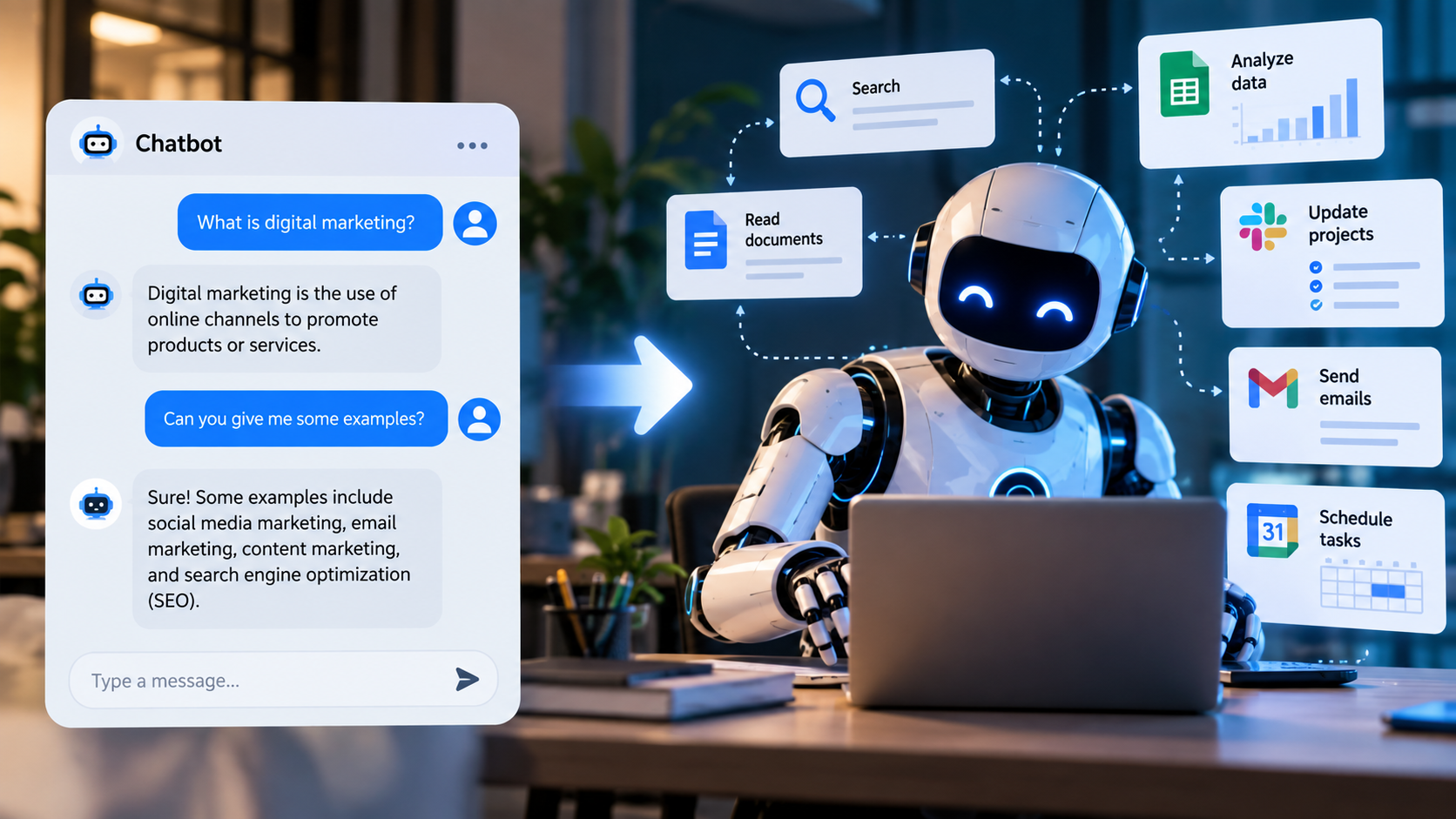
For the past few years, our daily interaction with artificial intelligence has happened inside a familiar box: the chat window. Whether you wanted to draft a professional email, summarize a lengthy report, or brainstorm ideas, the process was always the same. You typed a prompt, waited a few seconds, and read the generated text.
While these conversational tools were impressive, they left a massive gap in practical work. They could generate ideas, but they could not execute them. If an answer required pulling fresh data from a database, updating a record in a software system, or sending an official communication, the chatbot handed that work straight back to you. You were still the manual bridge between the AI’s words and the tools you use every day.
That reality is changing fast. AI Agents Are Moving Beyond Simple Chatbots, shifting technology from passive text generators into active, task-oriented software systems. Instead of waiting for word-by-word instructions, autonomous agents can take a high-level goal, figure out the necessary steps, interact with external applications, and finish complex tasks with far less hands-on oversight.
In this article, you will learn what makes an AI agent fundamentally different from a traditional chatbot, how these agentic architectures work behind the scenes, where they are being used today, and what operational risks organizations face as they adopt them.
The Big Shift: From Conversational Interfaces to Autonomous Action
To understand why this shift is taking place, consider how traditional generative AI operates. Standard chatbots use a single-turn model. You supply an input, and the model predicts the best sequence of words to answer that specific input. If the prompt asks for something involving real-world action—like scheduling a meeting or processing a customer refund—the chatbot can give you instructions on how to do it, but it cannot perform the action itself.
Autonomous AI agents, often described as agentic AI, flip this dynamic. Instead of answering isolated prompts, an agent accepts an open-ended objective and takes multi-step action to complete it.
For example, imagine asking a standard chatbot to handle a delayed customer order. The chatbot might draft a polite apology message for you to copy and paste.
An autonomous AI agent handles the process end-to-end:
-
It checks the inventory and shipping tracking logs to find the exact location of the package.
-
It verifies customer preferences and purchase history inside the company CRM.
-
It generates a personalized update, issues a partial shipping credit through the payment system, and sends the update directly to the customer.
-
It logs the action in the support ticket system and closes the case.
This change moves AI from a glorified search interface into a functional digital assistant that handles real administrative load.
Chatbots vs. AI Agents: What is the Real Difference?
It is common for software platforms to market basic conversational bots using terms like “intelligent agent,” which leads to confusion. The clearest way to tell the difference is to look at how each system responds when it runs into an obstacle.
A traditional chatbot follows rigid rules, canned scripts, or a single pass through a language model. If a user asks something slightly outside its programming or dataset, the bot stops, gives a generic canned response, or directs the user to a human agent.
An AI agent operates inside a feedback loop. It sets an objective, picks a tool, looks at the results of its action, fixes errors along the way, and continues until the task is complete.
Core Comparison: Chatbots vs. Autonomous AI Agents
| Feature | Traditional AI Chatbot | Autonomous AI Agent |
| Primary Goal | Generate conversational answers or text responses | Complete multi-step workflows and execute tasks |
| Operational Mode | Reactive; waits for a prompt to deliver one answer | Proactive; works through a planned sequence to reach a goal |
| Tool Usage | Limited or basic information lookup via predefined APIs | Dynamic access to web browsers, databases, custom code, and software APIs |
| Memory | Resets after every session or stays limited to the current chat window | Persistent memory layers across multiple sessions and connected systems |
| Error Handling | Fails or repeats incorrect text when it reaches a limit | Reviews mistakes, tries alternative tools, and adjusts its approach |
How AI Agents Actually Work Under the Hood
An AI agent is not just a single model that got smarter. It is a full software system that uses a Large Language Model as its central reasoning engine, surrounded by execution tools, memory systems, and evaluation loops. Four main components make this work:
1. Goal Decomposition and Planning
When you give an agent a broad prompt, its first step is breaking that prompt down into smaller, manageable sub-tasks. If you ask an agent to research a competitor, it does not try to generate a full report in one quick output. It plans a sequence: list key competitors, search for recent news on each, pull product feature lists, organize the findings into categories, and draft the final briefing document.
2. Tool Use and API Integration
A standard language model cannot interact with external software on its own. Agents are equipped with specific tools—such as web scrapers, database query connectors, software APIs, and sandboxed code execution environments. As the agent moves through its plan, it decides which tool to open and run based on what that specific step requires.
3. Contextual Memory Retention
Chatbots historically suffered from a lack of long-term memory, meaning every session started from square one. Modern agents use persistent memory layers. Short-term memory keeps track of what the agent did two steps ago in an active process, while long-term memory allows the agent to recall company guidelines, previous task runs, and user preferences across days or weeks.
4. Self-Evaluation and Reflection Loops
One of the defining features of agentic design is the feedback loop. Instead of delivering an answer immediately, an agent evaluates its own output. If an agent writes a script to fetch data and the script throws an error, the agent reads the error message, edits its code, and runs the script again until it succeeds.
Real-World Use Cases Across Industries
As companies look to move past basic chat interfaces, autonomous agents are being deployed in departments that handle repetitive, process-heavy tasks.
End-to-End Customer Support Resolution
Standard support bots excel at answering basic questions about return windows or office hours. AI agents take over actual resolution work. When a customer writes in to change an order, an agent can check policy limits, confirm identity, adjust the line items in the inventory database, issue an updated invoice, and send a updated confirmation email.
Software Engineering and Operations
In software development, agents act as technical assistants. Rather than just explaining how to fix a coding bug, an agent can clone a code repository, locate the bug in the files, write a patch, run local testing suites to make sure nothing broke, and submit a pull request for a human developer to review.
Sales, Marketing, and Administrative Workflows
Sales and marketing teams often lose hours to manual data entry across different platforms. Agents can scrape prospect lists, qualify lead records against ideal customer criteria, draft customized outreach messages, update pipeline statuses in a CRM, and alert account managers when a lead books a meeting.
Key Benefits of Adopting Agentic Systems
Moving from simple conversational chatbots to autonomous agents offers clear operational advantages:
-
Saves Hours on Repetitive Tasks: Employees spend less time clicking between screens, copying values from spreadsheets, and performing routine data entry.
-
Connects Siloed Software: Agents work across different platforms using APIs, bridging gaps between separate CRMs, project tools, and billing software.
-
Scales Workloads for Small Teams: Lean operations can manage higher volumes of support tickets, lead reviews, or data tasks without needing to expand headcount rapidly.
-
Reduces Human Transfer Errors: By automating routine data handoffs between systems, agents minimize manual typos and skipped steps in standard procedures.
Common Pitfalls, Risks, and Governance Challenges
While autonomous AI offers clear potential, deploying systems that take real-world actions introduces practical risks that organizations must manage carefully.
Escalating API and Compute Costs
A basic chatbot run takes a single prompt and returns a single answer. An agent, however, may run through ten or fifteen separate reasoning loops, calling external tools and re-evaluating context multiple times to complete one goal. This means agentic workflows consume significantly more computational resources and can cause API costs to rise quickly if not monitored.
Reliability and Unintended System Actions
If a chatbot generates incorrect text, a human reader can simply spot the mistake and ignore it. But if an AI agent misinterprets a command while connected to live production software, it can make unintended changes across databases before anyone notices. Without clear boundaries, automated mistakes can scale fast.
Security, Permissions, and Data Privacy
Granting software write permissions to internal databases, financial tools, or customer records creates security vectors. Companies must enforce strict credential access, use isolated sandbox spaces for untrusted tasks, and maintain “human-in-the-loop” approval gates for high-stakes decisions like sending payments or deleting files.
Frequently Asked Questions
What is the primary difference between a chatbot and an AI agent?
A chatbot focuses on conversation and text generation, responding to user prompts one at a time. An AI agent focuses on execution, using planning, memory, and external tools to carry out multi-step processes autonomously.
Will AI agents replace human employees?
AI agents are designed primarily to handle repetitive, multi-step administrative processes. They still require human oversight for strategic decisions, creative problem-solving, and managing high-stakes actions that require personal judgment.
How do AI agents connect to existing business software?
Agents connect to internal systems and external tools using Application Programming Interfaces (APIs), database connectors, and web browser integrations. This lets them read data, execute commands, and update records across different platforms.
Why do AI agents cost more to run than standard chatbots?
A chatbot makes one API call per user query. An agent makes multiple sequential API calls to reason, select tools, review work, and complete a full workflow, leading to higher overall compute usage.
Are AI agents prone to hallucinating or making errors?
Yes. Because agents rely on underlying language models, they can misinterpret vague instructions, select the wrong tool for a step, or get stuck in logic loops if tasks are not well-defined.
Conclusion
The evolution from simple chatbots to autonomous AI agents marks a major shift in how we interact with technology. We are moving away from an era where AI simply answers questions, toward an era where AI actively helps us run operational workflows.
While organizations must handle real challenges around compute costs, security permissions, and operational oversight, the value of task-driven AI is clear. Success with this new technology comes down to starting with clearly defined workflows, putting strong guardrails in place, and using agents to support human talent rather than relying on total automation. Read more about ai agents are changing how people use computers