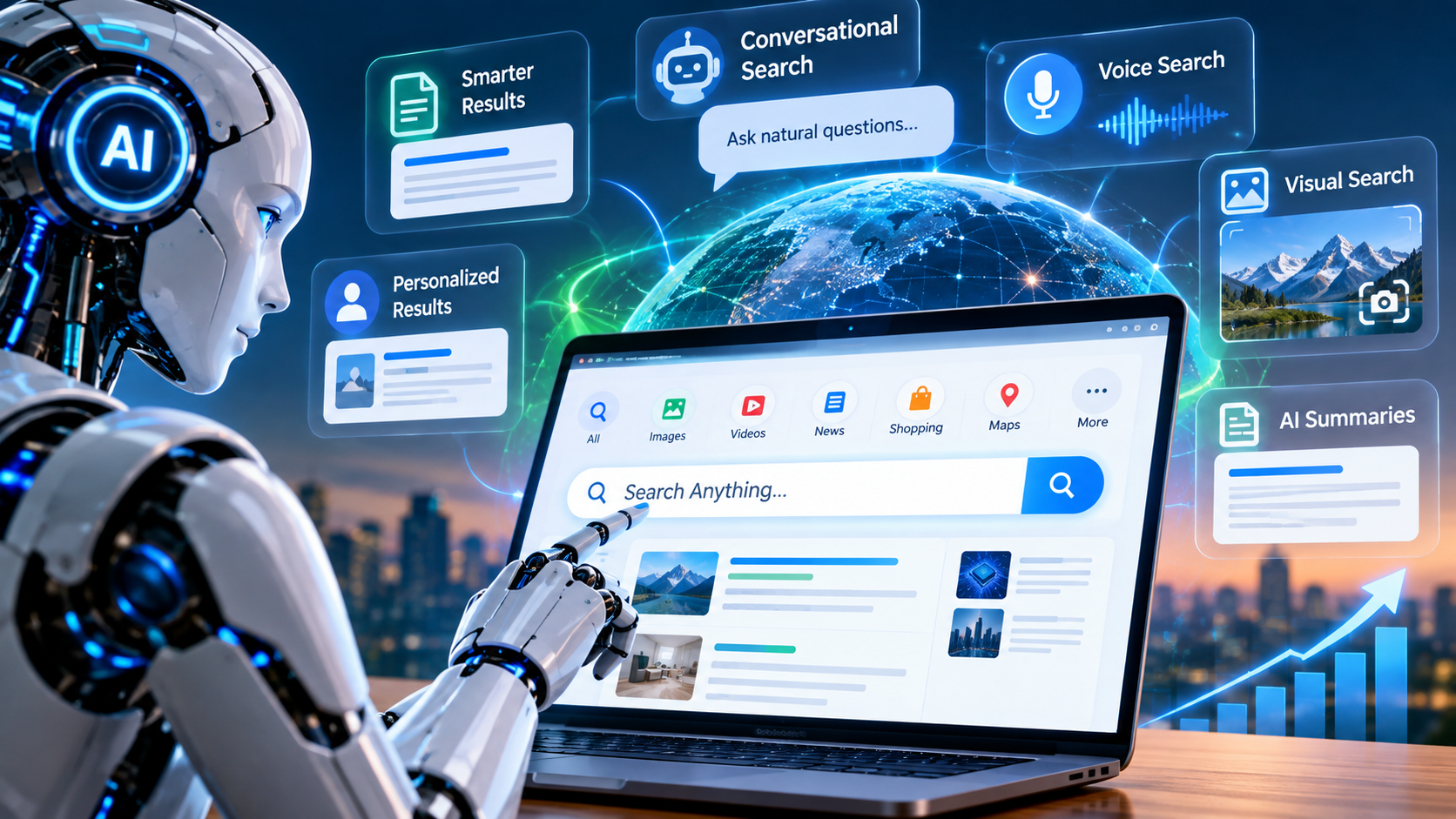
For more than two decades, online search has been one of the most important ways people find information on the internet. A person types a few words into a search engine, receives a list of web pages, and chooses the result that appears most useful. This simple process has shaped how websites are built, how businesses reach customers, and how people discover news, products, services, and answers.
Artificial intelligence is now changing that process.
Modern AI can understand questions in natural language, identify context, summarize information, compare different sources, and generate answers instead of simply returning a list of links. As AI becomes more deeply connected with search technology, the traditional search experience is moving from “find information” toward “understand information.”
This shift is changing what users expect from search engines and creating new opportunities and challenges for website owners, businesses, content creators, and SEO professionals.
From Keywords to Conversations
Traditional search depends heavily on keywords. When someone searches for a phrase such as best laptops for students, a search engine identifies pages that contain relevant words and evaluates hundreds of other signals to determine which results may be useful.
AI allows search systems to understand the meaning behind a query more deeply.
Instead of searching for short keyword combinations, users can ask complete questions. They can explain their situation, add preferences, ask follow-up questions, and refine the conversation without starting from the beginning.
For example, a user might ask:
“I need a lightweight laptop for university. I study computer science, have a limited budget, and want something with good battery life.”
An AI-powered search system can interpret these requirements together. Rather than treating every word as an isolated keyword, it can understand that the user is looking for a specific combination of features.
This makes search more conversational and personalized.
The change is important because people often know what they want to accomplish but do not know exactly which keywords they should use. AI can help bridge that gap.
AI Search Can Provide Direct Answers
One of the biggest changes brought by AI is the ability to provide a direct answer instead of forcing users to visit multiple websites.
Traditional search results usually present links, titles, descriptions, images, videos, maps, and other features. Users then visit different sources and combine the information themselves.
AI-powered search can perform part of that research process automatically.
For example, someone researching a technology topic may ask an AI search system to explain the differences between two technologies. Instead of returning dozens of pages, the system may summarize the major differences and provide supporting sources for further reading.
This can make information discovery faster.
However, direct answers also create a major challenge for publishers. If users can obtain useful information directly from a search interface, they may have less reason to click on individual websites.
This means website owners need to think about value beyond simply answering basic questions.
Search Is Becoming More Personalized
AI can use context to make search results more relevant to individual users.
Traditional search already uses various signals to improve relevance, but AI can potentially interpret much richer information about what a person is asking and why they are asking it.
For example, a person researching travel may first ask about destinations, then ask about hotels, transportation, weather, restaurants, and activities. In an AI-powered environment, these questions can become part of one continuous research process.
The search system can understand that the later question is connected to the earlier conversation.
This creates a more natural experience.
Instead of repeatedly explaining the same requirements, users can continue the conversation and ask increasingly specific questions.
Personalization may become particularly important for shopping, education, travel, business research, technology, and other areas where users have different needs and preferences.
AI Can Understand Different Types of Content
Search is no longer limited to text.
Modern AI systems are increasingly capable of understanding images, audio, video, documents, and other forms of information.
This creates a multimodal search experience.
A user could potentially upload an image and ask what it contains, describe a problem using voice, provide a document for analysis, or combine text and images in a single search request.
Imagine taking a picture of a computer component and asking, “What is this part, and what does it do?”
Instead of typing a complicated description, the user can provide the image directly.
Similarly, someone could upload a product photograph and ask for information about its features or alternatives.
This makes search more accessible because users do not always need to know the correct words to describe what they are looking for.
AI Is Changing How People Discover Websites
Search engines have historically served as gateways to websites.
A user searches for something, sees several results, clicks a page, reads the content, and may visit additional pages on the same site.
AI search can change this journey.
Users may discover information through an AI-generated summary before deciding whether they need to visit the original source. This makes the visibility of a website within AI-generated answers increasingly important.
For businesses and publishers, the goal is therefore becoming broader than simply ranking for traditional search queries.
They need to create content that is useful, trustworthy, clear, and easy for search systems to understand.
Strong website structure, accurate information, expert knowledge, original research, helpful explanations, and clear topical coverage can all contribute to a website’s ability to become a useful information source.
The Future of SEO Is Changing
Artificial intelligence is also changing search engine optimization.
For years, SEO strategies focused heavily on keywords, backlinks, technical optimization, metadata, and rankings.
These elements remain important, but search is becoming more focused on meaning and usefulness.
AI-powered systems can understand relationships between concepts, recognize context, and evaluate information at a deeper level than simple keyword matching.
This means content creators should avoid writing primarily for search engines.
Instead, they should focus on creating content for real users.
A high-quality article should answer the reader’s questions clearly, provide useful details, explain complex ideas simply, and offer information that cannot easily be replaced by a generic summary.
SEO is increasingly becoming a combination of technical optimization, topical expertise, content quality, authority, user experience, and trust.
Quality Content Matters More Than Ever
The growth of AI-generated content has created an enormous amount of information online.
Anyone can now use AI tools to generate articles, descriptions, summaries, and other text within seconds.
This creates a problem.
If millions of websites publish similar AI-generated content, search engines and users have little reason to value one page over another.
As a result, original and genuinely useful information can become more important.
Websites can differentiate themselves by adding original research, first-hand experiences, expert commentary, unique data, case studies, examples, interviews, comparisons, and practical advice.
For example, an article about smartphones becomes more valuable when it includes real testing, detailed comparisons, performance observations, and specific recommendations based on clearly explained criteria.
AI can help create content, but human expertise and originality can make that content more valuable.
AI Can Improve Search Accuracy, but Challenges Remain
AI-powered search has significant potential, but it is not perfect.
AI systems can sometimes misunderstand questions, provide incomplete information, or generate incorrect statements. This is especially important when users search for sensitive or complex subjects.
A confident-looking answer is not automatically a correct answer.
For this reason, trustworthy search systems need reliable information sources, strong verification processes, and mechanisms that allow users to examine supporting evidence.
Users also need to develop better habits.
When information is important, it is still wise to check the original source, compare reputable sources, and consider the date and context of the information.
AI can make research faster, but faster does not always mean more accurate.
Search Results May Become More Interactive
The future of search may look less like a page of links and more like an interactive research assistant.
Instead of asking one question and starting a completely new search, users may be able to build an entire research session.
For example:
“Find the major electric vehicle technologies.”
Then:
“Compare their advantages.”
Then:
“Which technologies are becoming more common?”
Then:
“Show me the companies working on them.”
The system can maintain context throughout the process.
This type of interaction could make complicated research significantly easier.
Students could use AI to understand difficult subjects. Businesses could research industries and competitors. Consumers could compare products. Professionals could investigate technical problems.
Search could become an ongoing conversation rather than a series of disconnected queries.
AI and Voice Search
Voice search is another area likely to benefit from AI.
People naturally speak differently from the way they type.
Instead of typing “weather Islamabad tomorrow,” a person might say, “What will the weather be like in Islamabad tomorrow morning?”
AI is better suited to understanding conversational language and context.
Voice search can therefore become more natural as AI systems improve their ability to understand speech, intent, accents, and follow-up questions.
This could make search particularly useful while driving, cooking, working, exercising, or performing other activities where typing is inconvenient.
AI Search and E-Commerce
Online shopping is another major area being transformed by AI.
Traditional product searches often require users to browse numerous product pages, compare specifications, read reviews, and decide which product fits their needs.
AI can simplify this process.
A user might describe what they need:
“I want a laptop for video editing with a strong processor, good display, and long battery life.”
An AI-powered shopping assistant can help organize the requirements and compare relevant products.
The same approach can be applied to smartphones, cameras, home appliances, software, clothing, and many other categories.
For businesses, this means product information needs to be accurate and comprehensive. Clear specifications, detailed descriptions, useful images, structured information, customer reviews, and trustworthy brand information can become increasingly important.
Local Search Is Also Evolving
AI can make local search more conversational.
Instead of searching separately for restaurants, opening hours, locations, parking, and reviews, users may ask a single detailed question.
For example:
“Find a family-friendly restaurant nearby that is open tonight and has vegetarian options.”
The search system can potentially combine multiple requirements and provide a more useful response.
This changes how local businesses need to think about online visibility.
Having accurate business information across important platforms becomes essential. Businesses should keep their addresses, phone numbers, opening hours, services, and other information up to date.
A strong online reputation and useful customer information can also help businesses stand out.
What This Means for Website Owners
Website owners should not assume that AI will make traditional SEO irrelevant.
Instead, search is evolving.
Technical SEO remains important because search engines still need to crawl, understand, and index websites.
However, websites should also focus on building authority around specific topics.
A strong website should have clear navigation, logical internal linking, fast performance, mobile-friendly design, useful content, accurate information, and a consistent topical focus.
Content should answer real questions instead of being created simply to target keywords.
It is also important to make important information easy to understand. Clear headings, concise explanations, useful examples, and well-organized sections help both users and search systems understand content.
Originality Will Become a Competitive Advantage
As AI-generated content becomes common, originality can become one of the strongest ways to differentiate a website.
Generic information is easy to reproduce.
Unique information is harder to replace.
A website that publishes original studies, expert interviews, practical experiments, industry data, personal experiences, detailed tutorials, or independent analysis can offer something more valuable than a generic AI-generated article.
This does not mean AI should be avoided.
AI can help researchers brainstorm ideas, organize information, identify gaps, improve drafts, and analyze large amounts of data.
The important factor is how the technology is used.
AI should support the creation of useful information rather than simply producing large quantities of repetitive content.
The Relationship Between AI and Human Expertise
The future of search is unlikely to be entirely about machines replacing people.
Human expertise remains important.
AI can process information quickly, but experts provide experience, judgment, context, and original knowledge.
A doctor, engineer, teacher, lawyer, researcher, journalist, or experienced professional may provide insights that cannot be created simply by combining existing web pages.
This makes expert-driven content especially valuable.
Websites that clearly demonstrate knowledge and provide reliable information may become stronger resources in an AI-driven search environment.
Privacy and Trust Will Become Important Issues
As AI search becomes more personalized, privacy will become increasingly important.
A more intelligent search system may need more context to provide better answers. This creates questions about how user information is collected, stored, processed, and protected.
Users will want to understand what information search systems use and how that information affects their results.
Trust will therefore become an important part of the future search experience.
Search companies will need to balance personalization and usefulness with transparency and privacy.
The Future of Online Search
The future of online search will likely combine traditional search engines, AI assistants, conversational interfaces, voice technology, visual search, and personalized recommendations.
The basic purpose will remain the same: helping people find useful information.
What changes is how that information is delivered.
Instead of entering a few keywords and browsing ten blue links, users may increasingly describe a goal and receive a contextual response supported by relevant sources.
Search will become more conversational, interactive, multimodal, and personalized.
For website owners and SEO professionals, this transformation creates both challenges and opportunities. Ranking alone may no longer describe the entire search journey. Visibility within AI-generated answers, strong topical authority, trustworthy information, and unique content may become increasingly important.
Conclusion
Artificial intelligence is changing online search from a system primarily focused on finding web pages into a more intelligent system designed to understand questions, context, and user intent.
AI can make information discovery faster and more conversational. It can understand text, images, voice, and other forms of information while helping users research complicated subjects with fewer steps.
At the same time, the rise of AI creates important challenges. Incorrect information, repetitive AI-generated content, reduced website traffic, privacy concerns, and questions about source credibility will need continued attention.For businesses, publishers, and SEO professionals, the most important lesson is simple: search is becoming more focused on usefulness and meaning.Read more about AI Agents Are Changing How People Use Computers